
Take a Letter, Darling (1942)

Toronto Film Society presented Take a Letter, Darling (1942) on Monday, August 11, 1986 in a double bill with Lady in the Dark as part of the Season 39 Summer Series, Programme 5.
Production Company: Paramount. Producer: Fred Kohlmar. Director: Mitchell Leisen. Screenplay: Claude Binyon, from a story by George Beck. Editor: Doane Harrison. Photographer: John Mescall. Art Direction: Hans Dreier, Roland Anderson. Music: Victor Young. Gowns for Rosalind Russell (Irene); for Constance Moor (M. Leisen).
Cast: Rosalind Russell (A.M. MacGregor), Fred MacMurray (Tom Verney), Constance Moore (Ethel Caldwell), Macdonald Carey (Jonathan Caldwell), Robert Benchley (G.B. Atwater), Cecil Kellaway (Uncle George), Charles E. Arnt (Fud Newton), Kathleen Howard (Aunt Minnie), Margaret Seddon (Aunt Judy), Dooley Wilson (Moses), George H. Reed (Sam), Margaret Hayes (Sally), Sonny Boy Williams (Mickey Dowling), John Holland (Ex-secretary), Dorothy Grainger (Switchboard Operator), Katherine Booth (Blonde steno).
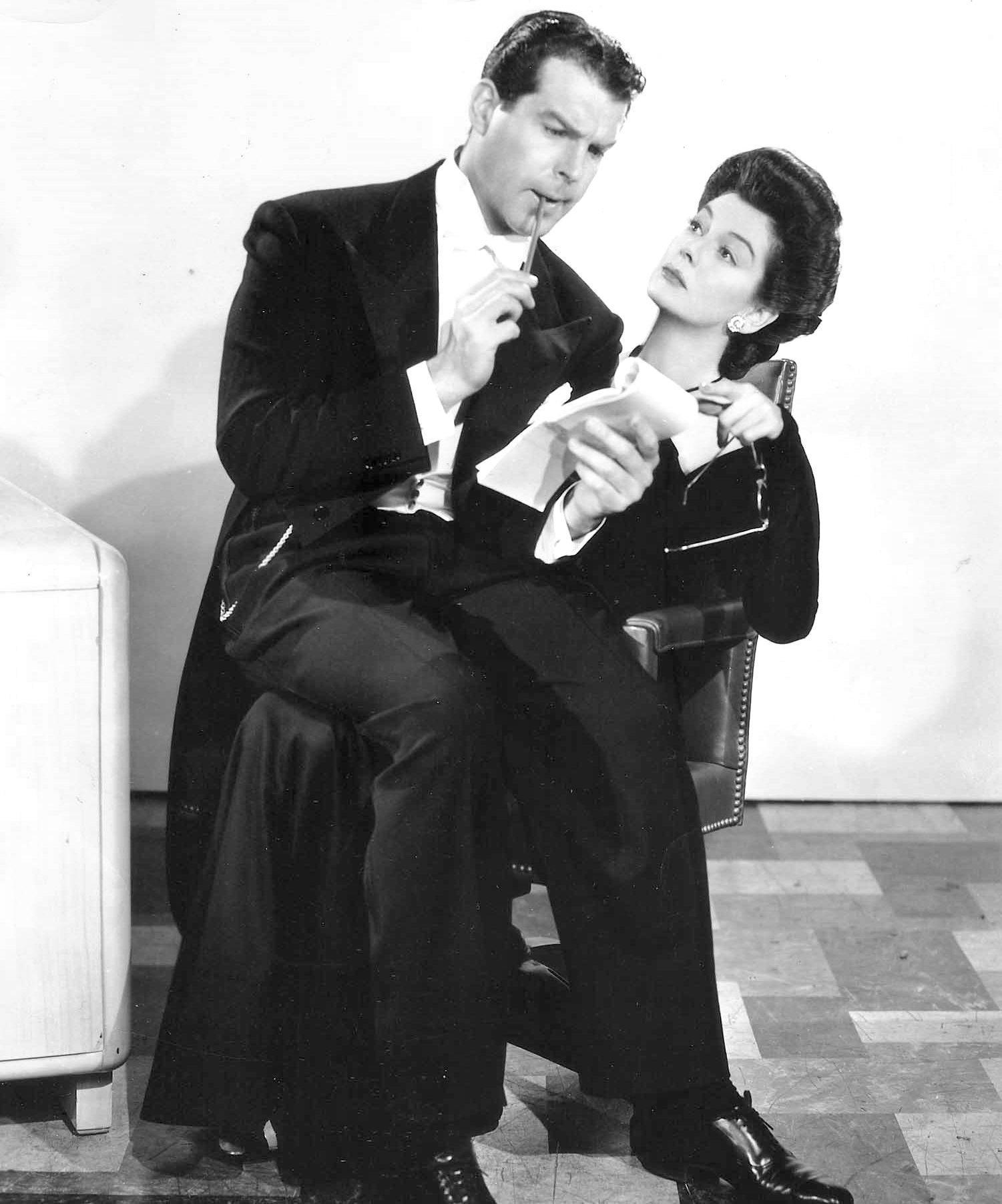
Tonight we take a look at women in business, or, at least, Hollywood’s Version of the professional woman. Rosalind Russell scores more successfully in this kind of part, but if their roles had been reversed, even Roz would have had some difficulty with her characterization amidst the wondrous goings–on that Ginger Rogers coped with in Lady in the Dark.
Claudette Colbert was the original choice for Take a Letter, Darling but was borrowed, with Mitchell Leisen’s consent, for The Palm Beach Story when Carole Lombard was being difficult. Frances Farmer was to be the second female lead. When Barbara Stanwyck turned the film down it was accepted by the free-lancing Rosalind Russell, and Constance Moore replaced the “fractious” Miss Farmer. The role could not have suited Russell more perfectly than if it had been written for her.
In his book on Rosalind Russell, Nicholas Yanni accurately observed: “The part of an advertising executive named A. M. MacGregor immediately solidified her hold on the screen’s high-pressured boss-lady roles. Her combination of comic intelligence and femininity was overwhelming. Fred MacMurray was the perfect foil as her personal secretary who escorted her on social occasions, performing “personal” duties, and other similar tasks which must have uplifted the hearts of female secretaries in audiences around the country.
“While falling in love with Russell, MacMurray tries to tell her she is ‘all business and no pulse,’ but she counters that she is ‘more woman than you’ll ever know.’ And we have no doubt at all about what she means. Perhaps because of this unique combination of businesslike and feminine qualities, Russell may not have been an overwhelming favourite with the male members of the moviegoing audience. But roles such as this went far to prove the thesis that if other avenues were open to women (other than being just a housewife-homemaker-lover-mother), perhaps their energies might not so often be turned in on themselves with the kind of destructive force and malice seen in the character of Harriet Craig.
“Russell legitimized the notion of a clever, funny girl onscreen–one who could be counted on to be both witty, sassy, sane and when the proper moment arose–also romantic. Unlike the stereotyped heroine, she could almost always be counted on to avoid being taken in by sham–unless succumbing to the man in the last reel might be considered being “taken in.” but then what audiences most remember in all of Russell’s “career women” pictures (and there were over twenty of them) is not that she eventually wound up falling in love with the hero and giving up her successful career–but that she had a successful career at all! As the career–heroine with a genuine personality, Russell almost always assumed a masculine toughness in her attitude towards romance, yielding to the man’s charms only when he accepted her in her own right–a truly novel notion for the movies.
“The best scenes take place early in the film when unsuccessful artist MacMurray enters the advertising agency and is eyed by all the employees as Miss MacGregor’s next ‘you-know-what’. When the startled MacMurray first meets executive Russell he tells her: ‘They didn’t tell me MacGregor was a lady,’ and Russell quickly corrects him–‘is a lady!’. Actually her purpose for hiring him is strictly legitimate–at first: to calm the suspicious wives of her clients. (She instructs MacMurray: ‘A woman in business faces many problems that men don’t–among those problems are men!’)”
The two leads are excellent, as is Constance Moore, an actress who should have been a bigger star but apparently was more interested in her family. MacDonald Carey (in his film debut) is quite good as the millionaire who first proposes to Russell, and as always, Robert Benchley is very amusing. The Claude Binyon script is clever and Mitchell Leisen’s direction is well paced and adroit. All in all, a most enjoyable romp.
You may also like...

-

Thank You from TFS!
Our matinée on Sunday, August 17th – at the blessedly air conditioned Paradise Theatre – will conclude the Toronto Film Society’s 77th season! But take heart, as we’ll be...

Sunday Afternoons at the Paradise
Join TFS for Season 78’s Sunday Matinée Series generously sponsored by our good friend, author and documentary filmmaker, Mr. Don Hutchison. Please save this date and visit us regularly...


