
The Lost World (1925) and King Kong (1933)
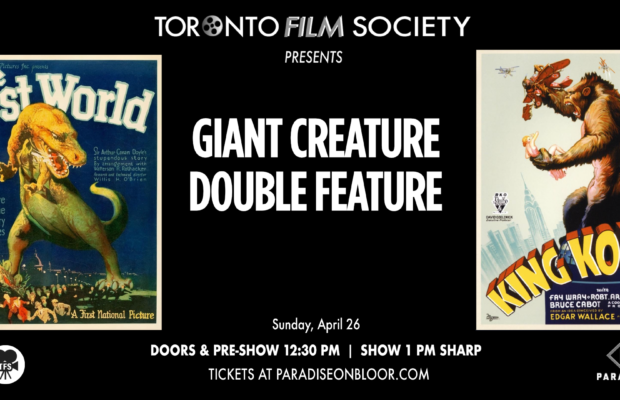
Toronto Film Society presented The Lost World (1925) on Sunday, April 26, 2026 in a double bill with King Kong (1933) as part of the Season 78 Series, Programme 6.
THE LOST WORLD (1925)
Production Company: First National Pictures. Produced by: Earl Hudson. Director: Harry O. Hoyt. Screenplay: Marion Fairfax, based on the novel “The Lost World” by Arthur Conan Doyle. Cinematography: Arthur Edeson. Film Editor: George McGuire. Release Date: February 2, 1925. Running time: 106 minutes.
Cast: Bessie Love (Paula White), Lewis Stone (Sir John Roxton), Wallace Beery (Prof Challenger), Lloyd Hughes (Ed Malone), Alma Bennett (Gladys Hungerford), Arthur Hoyt (Prof Summerlee).
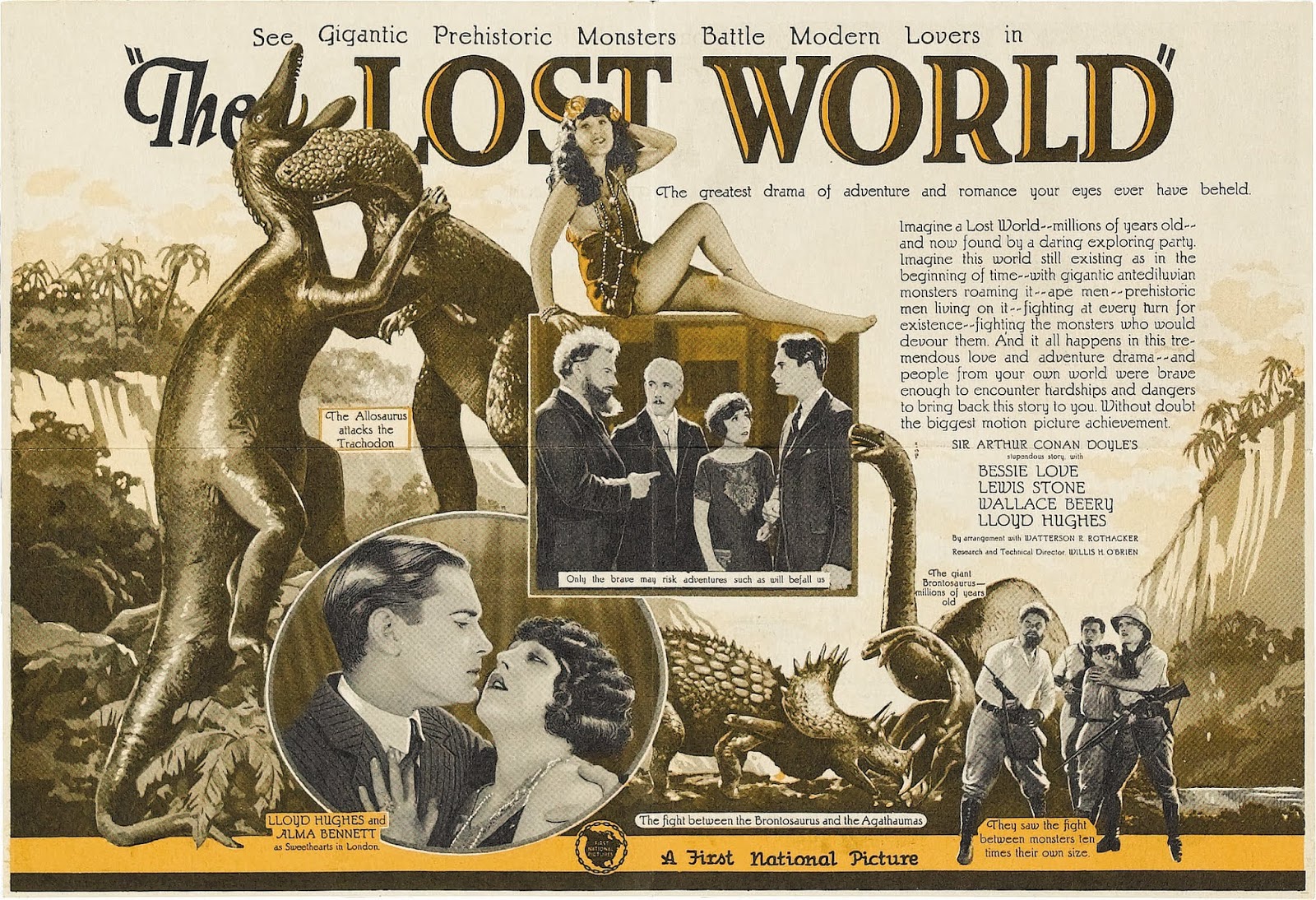
The Lost World was the first feature-length film made in the United States, and possibly the world, to feature model animation as the primary special effect. A full sixty-eight years before Jeff Goldblum graced the screen shirtless after being attacked by a T-Rex in Jurassic Park (1993), The Lost World thrilled audiences with a lifelike and terrifying parade of dinosaurs (in fact, Michael Crichton’s sequel to Jurassic Park was named The Lost World in homage to Doyle’s novel and this film). Without sharing the film’s origins, Conan Doyle showed clips of the movie to The Society of American Magicians in 1922, including Harry Houdini, and the next day The New York Times reported that his “monsters of the new world which he has discovered in the ether, were extraordinarily lifelike. If fakes, they were masterpieces.”
The Lost World is a prelude to other more commonly known monster adventure films, including King Kong (1933), on which Willis H. “Obie” O’Brien, stop motion pioneer, also worked. Obie, an avid film fan, came up with idea to animate the clay models he had been working on in a sculpting shop. His employer Watterson R. Rothacker happened to have the film rights for The Lost World and so they began to work at bringing the project to life together. With his team, Obie created about fifty models with ball-and-socket skeletons, rubber muscles, and latex rubber exteriors for the film – he even added small bladders in the models’ chests to simulate breathing!
A laborious process, it took Obie and his assistants 960 frames of film to achieve one minute of stop motion footage in walled off sets up to 150 feet long and seventy-five feet wide, and often the models had to be repaired at the end of the day due to wear and tear. The film features scenes with both the animated dinosaurs with live-action footage of human beings, which Obie at first achieved by through split-screen. However, his technique improved as filming progressed to the point where he could have both in one screen. After production, several of the dinosaur models were donated to the Museum of Arts and Sciences at Exposition Park in Los Angeles, and a few allegedly still survive today.
Originally 90 minutes long, the film has gone through many iterations. When Warner Brothers purchased First National Pictures, they cut 30 minutes of the movie, and in 1948 the 60-minute version was purchased by Encyclopedia Britannica who shrunk it down to a 5-min film intended for English classrooms and retitled it A Lost World, as Told by A. Conan Doyle.
In 1992 a near-complete print of the full film was discovered in the Filmovy Archiv of the Czech Republic, and additional footage was uncovered in a pair of private collections and in the Library of Congress, resulting in a new restoration in 1997.
Though the real stars of the show are the triceratops, allosauruses, stegosauruses and, of course, the uncharacteristically aggressive and wily brontosaurus, The Lost World also features a charming cast of humans. Wallace Beery, Best Actor Academy Award Winner for The Champ (1931), plays Professor Challenger, ridiculed by most of his peers for insisting dinosaurs are alive and well and roaming a plateau in the borders of Peru, Brazil, and Colombia. World traveler and explorer, Sir John Roxton is played by Lewis Stone, contract player at Metro-Goldwyn-Mayer, Lloyd Hughes plays Edward Malone, and Bessie Love, whose career spanned 7 decades, is played by Paula White.
Their motivations to embark on the expedition are primarily not exploitative in nature – for Challenger and White it is to rescue and redeem her father, Maple, and for Malone it is to impress his fiancée with his bravery and worldliness. Interestingly, Conan Doyle sites Challenger, not Sherlock Holmes, as his favourite created character.
When they reach the plateau, mayhem ensues and the film culminates with the brontosaurus escaping when being lifted from the boat that transported him from South America, then swimming away in the Thames river – a perfect opening for a sequel, but this was in an era that pre-dated the Hollywood franchise machine. In 1998 The Lost World was deemed “culturally, historically or aesthetically significant” by the Library of Congress and selected for preservation in the United States National Film Registry.
A few more ‘fun facts’ about The Lost World:
- For live action scenes, an open sewer behind the MGM studio was used as a river.
- In April 1925, on a London-Paris flight by Imperial Airways, The Lost World became the first in-flight film to be shown to passengers.
- An early prologue that was lost showed Conan Doyle examining Obie’s models before sitting down at a typewriter to write The Lost World.
- During the London scenes we see a theater marquee advertising The Sea Hawk, in which both Wallace Beery and Lloyd Hughes were appearing.
Notes by Kathleen McLarty
KING KONG (1933)
Producers: Merian C. Cooper, Ernest B. Schoedsack. Directors: Merian C. Cooper, Ernest B. Schoedsack. Screenplay: Edgar Wallace, James Creelman, and Ruth Rose, based on a story by Edgar Wallace. Cinematography: Eddie Linden, Vernon Walker, J.O. Taylor. Film Editor: Ted Cheesman. Music: Max Steiner. Release Date: March 2, 1933. Running time: 100 minutes.
Cast: Fay Wray (Ann Darrow), Robert Armstrong (Carl Denham), Bruce Cabot (Jack Driscoll), Frank Reicher (Capt. Englehorn).
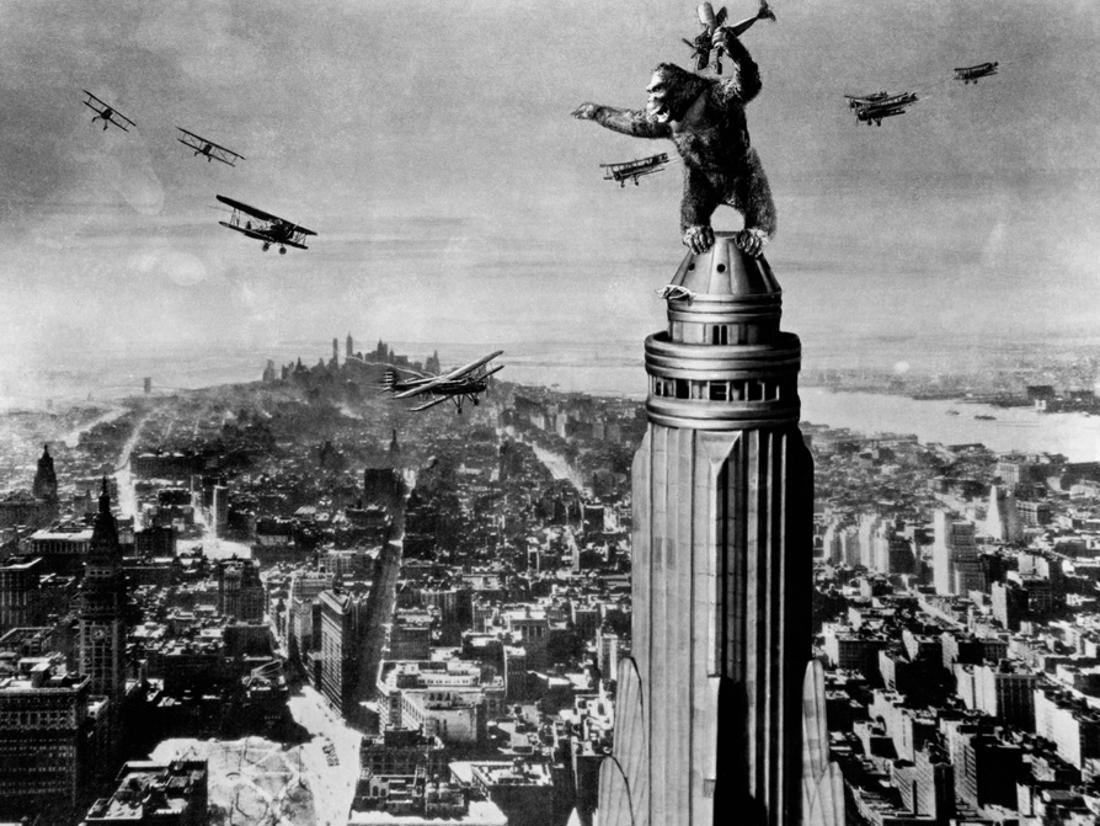
Discussing what the most “important film of all time” is can be a difficult, if not impossible, thought experiment. One must consider every aspect of a production, from its behind-the-scenes history to technical accomplishments, to the time period in which the film was released, to begin to derive an answer remotely. When it comes to asking this question, many possible answers emerge. Some might argue in favour of early works like Georges Méliès’s A Trip to the Moon from 1902. Others might suggest the artistic success of Hitchcock’s Vertigo or the popularity of 70s blockbusters such as Jaws or Star Wars.
While impossible to ascertain what is, in fact, the most important movie ever made, one film in particular fits the bill more than most and may just be the movie that has inspired filmmakers more than any other in the history of the medium. That being the 1933 epic, King Kong.
Released in 1933, King Kong follows a group of filmmakers led by director Carl Denham (Robert Armstrong) as they embark via the S.S. Venture on an expedition to the mysterious Skull Island to shoot his latest film. Along with his lead actress, the beautiful Ann Darrow (Fay Wray), and the stern but heroic first-mate, Jack Driscoll (Bruce Cabot), he lands on Skull Island. There, Ann is taken captive by the natives of the island to be sacrificed to their god, the giant ape called Kong. As Denham, Driscoll, and the crew of the Venture attempt to rescue Ann from Kong, they are accosted by the various prehistoric creatures on the island. All the while, Ann forms a bond with the island’s king.
Directed by filmmakers Merian C. Cooper and Ernest Schoedsack, King Kong is in many ways the perfect modernization of the classic “beauty and the beast” tale, combining the melodramatic romance that film fans of the time were accustomed to seeing in the form if Ann and Jack’s would be romance (he very quickly expresses his love for her after meeting) and the relationship which forms between Ann and Kong himself, a bond which is fated to come to bloody and disastrous end.
One of the most striking aspects of King Kong is its visual style. Obviously constrained by the technology of the time, the filmmakers managed to create a fantastical and self-contained world in the shape of Skull Island. Utilizing both location photography and soundstages, there is, at least to a modern audience, a noted disconnect between the filming locations. The beaches of California are open and bright. Even the native village, despite being a set, has a tangible and realistic nature to it. Contrasting this is the relative claustrophobic density of the jungle. Created using set dressings and backdrops, the jungle feels contained and stuffy. But this adds to the alien nature of Skull Island. The artificialness of the land makes us, the audience, feel as out of place on the island as the characters do. There is an unreality to it all, and despite that unreality, it paradoxically feels real.
What helps the island escape the constraints of the soundstage is the use of sound. The early 1930s were an era of transition for the film industry. Times were changing both economically, socially and technologically. On the technical front, synced sound was the biggest and newest invention to draw audiences into the motion picture palaces of the day. Even then, the combination of synced dialogue, sound effects, and an original orchestral score was rare during the infancy of the talkie. Cooper and Schoedsack sought an orchestral score from composer Max Steiner despite budgetary concerns. This was unique for the time, especially since other genre films, such as Universal’s Frankenstein and Dracula, lacked this feature until their own later sequels, despite having synced sound. The soundscape of King Kong is suitably alien in its presentation. The growls, chirps and calls of bizarre and otherworldly creatures in the dense jungle offer life and substance to a living and breathing ecosystem. In a similar vein, Max Steiner’s score is befitting of the world of Kong. It combines a traditional Hollywood score (with soft, romantic tones for Ann and Jack’s romance) with bombastic and action-oriented cues for Kong. In many ways, it feels of its time. But in others, specifically in its iconic title theme, it feels far ahead of it.
However, the most significant feat of King Kong is the special effects by pioneer Willis O’Brien, who truly brought the film’s world to life. At the time of the film’s release, O’Brien was no stranger to not only special effects but prehistoric fantasy as well. Early creative ventures of his were prehistoric stop-motion comedies like The Dinosaur and the Missing Link: A Prehistoric Tragedy, a short which led to “inventor” Thomas Edison hiring O’Brien to animate several short comedies in a similar vein. O’Brien’s fascination with dinosaurs and the world of the past would seemingly culminate when he animated the dinosaurs for Harry O. Hoyt’s 1925 adaptation of The Lost World, effects which were so realistic for the time that Lost World author Sir. Arthur Conan Doyle reportedly showed a reel of O’Brien’s footage to his friends, claiming that it was indeed real footage of dinosaurs.
While in the midst of production on his magnum opus, a film in which modern humans discover dinosaurs on an uncharted island entitled Creation for RKO, O’Brien found his film suddenly cancelled and he and his dinosaur armatures were brought onto the King Kong production, much to his delight. In the film, O’Brien and his team pioneered groundbreaking special effects techniques to bring the world of the film to life. Perhaps the most astonishing technique used by O’Brien and his team was the seamless union of live action and animated footage, achieved through rear projecting completed animated sequences behind the actors, the use of travelling mattes, and even projecting live action footage of the actors into the miniature scenes frame by frame. These elements, combined with full-scale Kong models such as his hands, feet and head, led to a level of realism and immersion never before seen in a film. For his efforts, O’Brien was to be honoured with an Oscar but refused when he learned that the rest of his effects team would not share the honour.
King Kong would be released in the spring of 1933, becoming one of the first true popcorn movies, a success inspired in many ways due to it being an escapist fantasy in the weeks and months coming off the height of the Great Depression. Kong astonished and terrified audiences and left an indelible impact on the film industry and popular culture as a whole. Multiple re-releases would occur throughout the years, and the film played continuously on television for decades, practices which ensured a long and prosperous legacy. During this time, several filmmakers would be inspired by the film and character, including famed effects pioneer and Godzilla co-creator Eiji Tsuburaya, as well as filmmaker Peter Jackson.
Compounding this success would be several projects which would be spawned from the film, including a hasty sequel entitled Son of Kong and a 1960s animated TV adaptation. The aforementioned Eiji Tsuburaya would get to pay tribute to one of his inspirations in the form of King Kong vs Godzilla and King Kong Escapes in 1962 and 1967, respectively. The two Japanese films would be the last pieces of Kong-related media before two big-budget Hollywood remakes of the original in 1976 and 2005, the latter of which was directed by lifelong Kong fanatic Peter Jackson. Even to this day, Kong continues to astonish audiences all around the world in several films from Legendary Pictures as part of their Monsterverse.
Perhaps, at the end of the day, arguing and debating about the most important film of all-time is arbitrary. But possible answers exist. Within those potential answers, few films (if any) could possibly be more important than the giant of cinematic legacy that is King Kong.
Notes by Ryan Tocheri
You may also like...

-
Support Classic Cinema: Toronto Film Society Sponsorship Opportunities
Toronto Film Society Corporate Sponsorship 2026/27 About TFS Founded in 1948, the Toronto Film Society is one of Canada’s oldest film appreciation groups. It was originally formed to meet...
Virtual Saturday Night at the Movies
Toronto Film Society will be screening Alfred Hitchcock’s Lady Windermere’s Fan (1925) straight to your home on Tuesday, September 29, 2026 at 7:15 p.m. (ET)! Directed by Ernst Lubitsch,...


