
Il Sorpasso (1962) and Orchestra Rehearsal (1978)
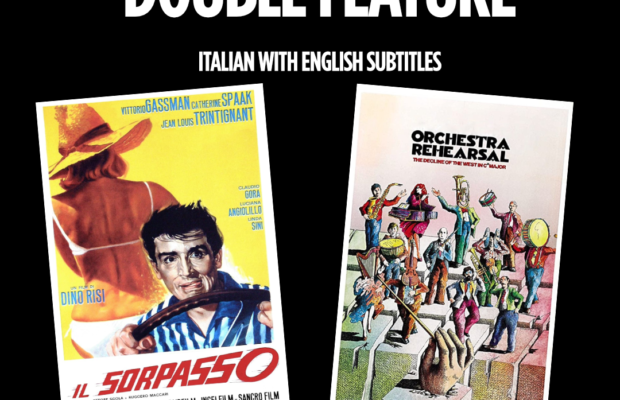
Toronto Film Society presented Il Sorpasso (1962) on Sunday, February 22, 2026 in a double bill with Orchestra Rehearsal (1978) as part of the Season 78 Series, Programme 4.
IL SORPASSO (1962)
Production Companies: Fair Film, Incei Film, Sancro Film. Producer: Mario Cecchi Gori. Director: Dino Risi. Screenplay: Rodolfo Sonego. Director of Photography: Alfio Contini. Editor: Maurizio Lucidi. Music: Riz Ortolani. Running Time: 108 minutes. Released December 6, 1962 in Italy.
Cast: Vittorio Gassman (Bruno Cortona), Catherina Spaak (Lilli Cortona), Jean-Louis Trintignant (Roberto Mariani), Claudio Gora (Danilo Borelli ‘Bibi’), Luciana Angiolillo (Gianna Cortona).
One of the great forms of cinematic entertainment is the buddy comedy. While many may say that cinematic achievements such as the implementation of synced sound, colour, and the creation of digital characters are among the great accomplishments of the film industry, one could also argue that the greater achievement was the concept of putting two goofy characters (in their own special ways of course) in a vehicle and forcing them to commute to a destination; facing all types of hijinks over the course of their journey. From Old Hollywood classics like Laurel and Hardy’s The Flying Deuces (1939) to comparatively more recent efforts like Planes, Trains and Automobiles (1987), the buddy comedy offers audiences the quintessential comedic scenario. But it is also a genre that forces us to reflect; for beyond the buffoonery, there is often a tale of personal struggle.
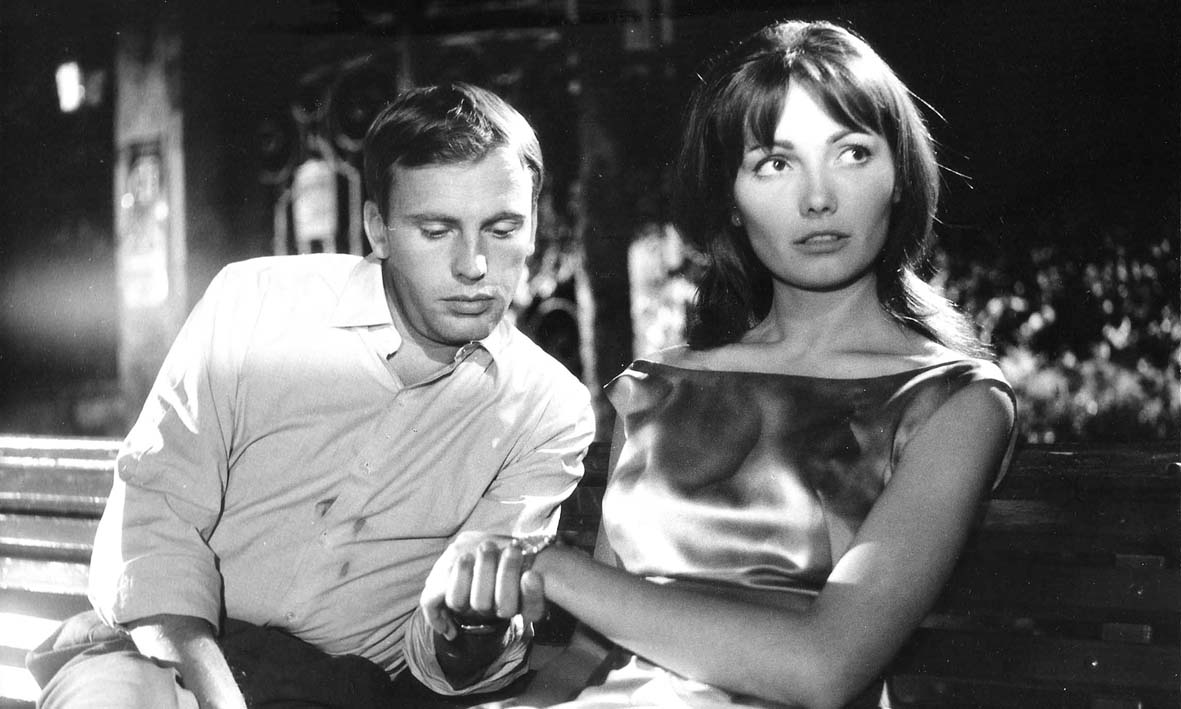
1962’s Il Sorpasso (The Easy Life) from director Dino Risi, in that regard, is in good company. The film follows two unlikely companions, Bruno (a reckless loudmouth played by Vittorio Gassman) and Roberto (Jean-Louis Trintignant’s timid and awkward law student). When the two unlikely companions come into contact due to Bruno asking to use Roberto’s phone, the duo is set off on an adventure as Bruno insists on taking his new friend out to eat as a thank you. Along the way, the two encounter a cavalcade of interesting characters and scenarios as Roberto tries to come out of his shell and Bruno is confronted with his past.
A defining aspect of the film is the relationship between the two leads. Bruno is a free spirit, the type of person who lives by his own rules. But it’s that aspect that is, in many ways, his downfall. As we begin to explore his wife and daughter (with whom he is estranged), we begin to see a facet of the character that is not present while he is flirting with beautiful women and recklessly speeding on the highway. We observe not just a form of regret, but pain. Pain from his mistakes, pain from those he hurt, and pain from what he might not be able to fix. He is a damaged person, one who is living a fast and loose life to replace the one that he had. On the opposite side of the spectrum is Roberto, someone who is just starting their life and beginning to emulate their new friend as their relationship blossoms. Despite reservations, Roberto sees a certain liveliness in his irresponsible friend. In some ways, they form a brotherly bond, similarly to how a younger sibling will begin to emulate their older brother or sister. In many ways, this is due to Roberto attempting to escape his own mundane life. He has not made the same mistakes that Bruno has, no, but perhaps he is on a collision course with fate.
These themes are compounded by the filmmaking style that director Risi employs over the course of Bruno and Roberto’s journey. One of the most prominent and still influential styles of Italian filmmaking was the neorealist movement of the post-war era. Movies such as film school classic Bicycle Thieves (1948) paved the way for a new wave of Italian cinematic storytelling using their own collective trauma from the Second World War to explore class, inequality and the social order. While not explicitly a part of the neorealist movement, some of these filmic aspects make their way into Il Sorpasso. The driving scenes as the two leads cruise the Italian countryside have an almost Vérité approach to their style; in no doubt due to the technical constraints of the time, but also clearly to add a sense of reality. As Bruno antagonizes drivers and even switches records on a whim, we are drawn into the cabin of his convertible with an air of dangerousness, but also one of intrigue. We’re a fly on the wall in a sense to these moments.
Similarly, while the movie remains a comedy, the drama gradually becomes more prominent in the story, exploring the lives of Bruno and his family. The film does have a sense of unreality to it (not many would get into a stranger’s car and joyride after three minutes of total interaction), but these grounded moments, where characters are confronted with the gravity of the world around them and their impact on it, take us back to a far more gritty and realistic look at the story. While the concept of a “dramedy” is far from unique today, the implementation of these elements in Il Sorpasso separates it from many of its contemporaries.
Il Sorpasso is considered to be one of the great Italian films, one that was seen to resonate with both contemporary and modern audiences alike. With its themes of youth, remorse, as well as both the positivity and dangers of evolving as a person, it is a film that forces the audience to confront themselves. And in many ways, that is not only the power of Il Sorpasso in particular, but also the power of filmmaking in general.
Notes by Ryan Tocheri
ORCHESTRA REHEARSAL (1978)
Producers: Michael Fengler, Renzo Rossellini. Director: Federico Fellini. Screenplay: Federico Fellini, Brunello Rondi. Cinematography: Giuseppe Rotunno. Film Editor: Ruggero Mastroianni. Music: Nino Rota. Release Date: December 4, 1978. Running time: 70 minutes.
Cast: Balduin Baas (Conductor), Clara Colosimo (Harp player), Elizabeth Labi (Piano player), Ronaldo Bonacchi (Bassoon player), Ferdinando Villella (Cello player), Franco Javarone (Bass tuba player).
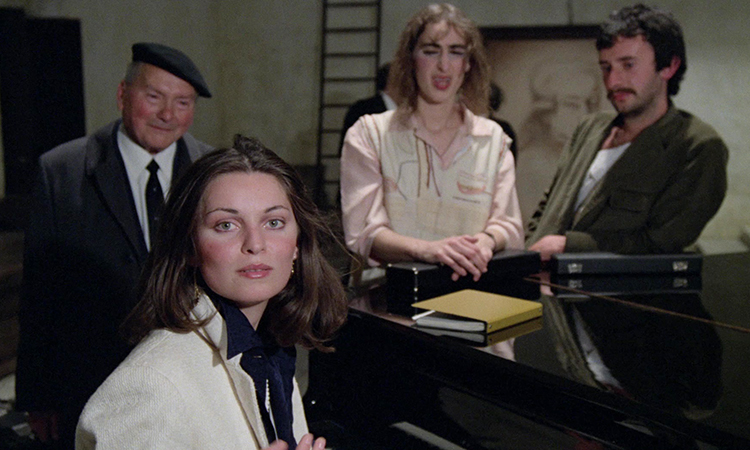
Orchestra Rehearsal (Prova d’orchestra) is a lesser known, made-for-Italian-television film directed and co-written (with Brunello Rondi) by the Italian master, Federico Fellini. At a tight run time of 70 minutes, it also contains Nino Rota’s last score for Fellini before the prolific composer’s death in 1979. Prompted by the 1978 kidnapping and murder of former Italian prime minister Aldo Moro by Red Brigade terrorists and loosely based on a real incident in 1975 when Fellini and Rota were present at a recording session being filmed for Italian TV and witnessed the musicians go on strike, the film is a departure from Fellini’s better known surrealist films and arguably his most satirical and political offering.
In this single-setting mockumentary, Fellini himself plays the role of off-camera interviewer asking questions of musicians while they prepare to rehearse in a 13th century church renowned for its exceptional acoustics. Tension arises when the German-born conductor of the orchestra informs the musicians they are being filmed without receiving any compensation, and the one-on-one interviews reveal feelings of individual superiority and signs internal discord (pun intended!).
Traffic noises and intermittent building tremors heighten a sense of chaos and uncertainty while the presence of union representatives further anger the authoritarian conductor. As the film progresses, petty squabbles escalate and erupt into full scale revolt complete with vandalism, physical altercations, and gunshots, culminating in a wrecking ball bursting through the church, seemingly a metaphor for the destruction of order and tradition, which buries the harpist in rubble.
With the rebellion halted by tragedy, the conductor takes this opportunity to eulogize with a declaration that the musicians must play through the pain of life. After a tour-de-force performance amongst the ruins, the conductor’s criticism and dictatorial leadership return in an escalated fashion, a nod to the violent resurgence of neofascism amidst intense social and political upheaval in 1970s Italy.
An underrated Fellini film, Orchestra Rehearsal’s commentary on the modern state of democracy and the human condition resonate as much today as when it was first released.
Notes by Kathleen McLarty
You may also like...
-

Thank You from TFS!
Our matinée on Sunday, August 17th – at the blessedly air conditioned Paradise Theatre – will conclude the Toronto Film Society’s 77th season! But take heart, as we’ll be...
Virtual Saturday Night at the Movies
Toronto Film Society will be screening Alfred Hitchcock’s Lady Windermere’s Fan (1925) straight to your home on Tuesday, September 29, 2026 at 7:15 p.m. (ET)! Directed by Ernst Lubitsch,...


