
Lady in the Dark (1944)
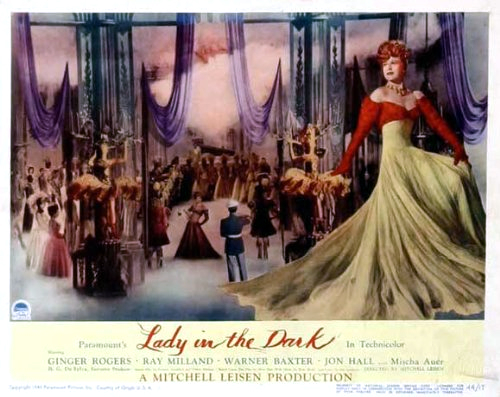
Toronto Film Society presented Lady in the Dark (1944) on Monday, August 11, 1986 in a double bill with Take a Letter, Darling as part of the Season 39 Summer Series, Programme 5.
Production Company: Paramount. Producer: Richard Blumenthal. Executive Producer: B.G. DeSylva. Director: Mitchell Leisen. Screenplay: Frances Goodrich and Albert Hackett (Mitchell Leisen); based on the play by Moss Hart with music by Kurt Weill and lyrics by Ira Gershwin. Editor: Alma Macrorie. Photographer: Ray Rennahan. Technical Effects: Paul Lerpae. Special Effects: Gordon Jennings. Process Photography: Fraciot Edouart. Art Direction: Hans Dreier. Sets and Costumes: Raoul Pene du Bois. Modern Costumes: Edith Head, Mitchell Leisen and Babs Wilometz. Set Decoration: Ray Moyer. Songs: Ira Gershwin and Kurt Weill; “Suddenly It’s Spring” by Johnny Burke and James Van Husen. Vocal Arrangements: Joseph J. Lilley. Orchestrations: Robert Russell Bennett, Miss Rogers’ dance, “Suddenly It’s Spring” by and with Don Loper; “The Circus” staged by Billy Daniels. Music Associate: Arthur Franklin.
Cast: Ginger Rogers (Liza Elliott), Ray Milland (Charley Johnson), Jon Hall (Randy Curtis), Warner Baxter (Kendall Nesbitt), Barry Sullivan (Dr. Brooks), Mischa Auer (Russell Paxton), Mary Phillips (Maggie Grant), Phyllis Brooks (Allison DuBois), Edward Fielding (Dr. Carlton), Frances Robinson (Girl with Randy Curtis), Don Loper (Adams), Mary Parker (Miss Parker), Catherine Craig (Miss Foster), Marietta Canty (Martha), Virginia Farmer (Miss Edwards), Fay Helm (Miss Bowers), Gail Russell (Barbara), Kay Linaker (Liza’s’ mother), Harry Stephen’s (Liza’s father), Rand Brooks (Ben), Billy Daniels (Office Boy).
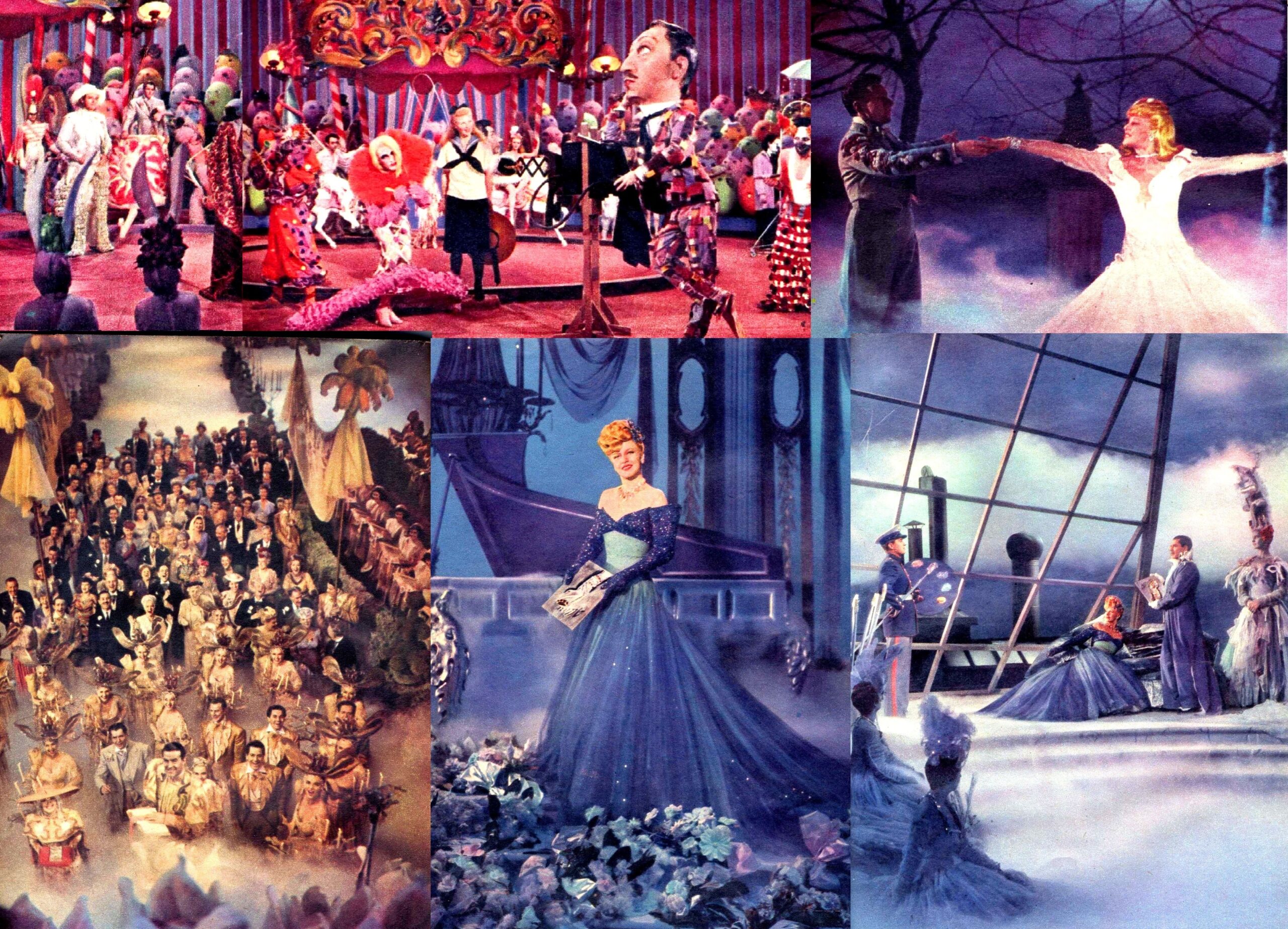
“The slightly terrific spectacle of a couple of million dollars all laid out in eye-dazzling costumes, dress creations and brilliant decor is something to which moviegoers have become inured. But never, in this writer’s memory, has the screen mounted such a display of overpowering splash and glitter as it does with Paramount’s Lady in the Dark. Imagine the gaudiest creations of all the fancy dressmakers in the trade; imagine the most resplendent spectacles of the Music Hall rolled into one; imagine a lacquered Ginger Rogers strolling sleekly through this compound mise en scene–and you have a moderate impression of this new film…. For the studio, to use a common idiom, has completely shot the works and turned out a Technicolored march–past which puts previous screen parades to shame.: So said Bosley Crowther in this New York Times review of February 23, 1944.
Variety raved: “Produced on a lavish scale in Technicolor and in very fine taste against backgrounds of a glittering character, with costuming that fills the eye, Lady in the Dark is a technically superior piece of craftsmanship. But more than that, in all directions, is extremely entertaining. It can’t miss being boffo at the box office…. In all departments including the direction, script, music, dance staging, lighting, photography and orchestration, nothing is to be desired. Photography in particular is the last word, notably the process shots…a plethora of many combinations of brilliant colors stamps this production as perhaps the finest ever turned out in tints, with the modern settings, dream backgrounds and costuming especially lending themselves to color treatment.”
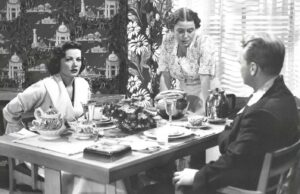
Lady in the Dark, was the climax of Mitchell Leisen’s career, his most ambitious work, and probably his highest grossing film. Audiences of the day loved it and it is still highly entertaining, though feminists will quite probably grit their collective teeth at some of the content. Interestingly, Ginger Rogers also reached the peak of her career and began her slow decline with this picture. “Ginger Rogers’ days of top stardom ending with this film,” writes David Chierichetti in Hollywood Director, “and what should have been the crowning achievement of Mitchell Leisen’s career ended up to be just another picture.” Maybe so, but the film can certainly be enjoyed as a visual treat. Some feel this is its problem. The purists bemoan what happened to the show on its way to be filmed, but the stage production was far too theatrical for mass consumption. It had first been turned down by Irene Dunne before Gertrude Lawrence was finally cast, and for the film none of the big female stars of the period could handle both the dramatic and musical requirements. Ginger Rogers wanted the part and got it because of a three picture deal with Paramount. It soon became apparent that her singing and dancing were fine, but her acting failed to capture all the nuances and ambiguities of Eliza Elliott’s complex psyche, so that the visual aspects of the film assumed far great importance in Leisen’s scheme of things as he tried to convey certain dramatic points. For the first time in his career, form overpowered content. Liza Elliott (Rogers), a brittle domineering top fashion editor, undergoes psychoanalysis to cure her mercurial moods, and is told by her psychiatrist that she privately desires to be more feminine. (!) This is the three outrageously extravagant dream sequences in which she is haunted by the men in her life–one occurs in a sea of blue as she poses for a new postage stamp. Another, coloured in gold, conjures a fantastic, unwanted wedding. The third imagines a surrealistic circus-like world in which she is brought before a tribunal to choose between her youthful self and her garishly glamourized self.
Apparently, Ray Milland heartily disliked the picture, felt Ginger Rogers was totally inappropriate, and got through the film by repeating over to himself “This too shall pass”.
Naturally, the studio vetoed any possible suggestion that the young Eliza, seen in flash-backs, might be in love with her father, one of the premises of the play. Executive Producer B.G. DeSylva also ruthlessly cut the song “My Ship” from the final print, over the protests of an angry Leisen–a critical deletion, since, in the story, the tune is supposed to have physically distressed Liza from her childhood. The scene occurs in another flash-back where the teenaged Liza, not invited to a prom, decides to spend the evening in the town library. There she finds a popular boy who’s had a fight with his girlfriend and she accepts his invitation to go with him. Pausing in a little park before entering the high school gymnasium, Liza remembers a tune that has haunted her since childhood. They sit down and she sings “My Ship”. The boy’s girlfriend then lures him away and she is left alone.
DeSylva, a songwriter himself, hated Weill’s music and insisted “My Ship” be cut. Furious, Leisen refused to shoot any covering shots that would allow a graceful excision of the song, so just as Liza is about to sing, there is a clumsy fade into the gymnasium, then a quick cut to the girlfriend coming out the door. Thus, a vital link in the storyline was lost.
We are very fortunate in having an original Technicolor print of this film–most prints are black and white. However, that said, I musts make note that the gaudiest and most lavish production number in the whole darn picture has been excised from our print–no doubt by an avid collector of “overblown moments from the movies.” This number is the circus scene, where Ginger Rogers sings “The Ballad of Jenny.” At this point, we are not sure if we should try to include this missing segment in black and white and, if so, if it should be inserted into the proper action sequence or shown separately at the end of the picture. Either way, it will be quite a wrench. We shall see. But do come and see this bizarrely entertaining movie.
You may also like...
-
Support Classic Cinema: Toronto Film Society Sponsorship Opportunities
Toronto Film Society Corporate Sponsorship 2026/27 About TFS Founded in 1948, the Toronto Film Society is one of Canada’s oldest film appreciation groups. It was originally formed to meet...
Virtual Saturday Night at the Movies
Toronto Film Society will be screening Alfred Hitchcock’s Lady Windermere’s Fan (1925) straight to your home on Tuesday, September 29, 2026 at 7:15 p.m. (ET)! Directed by Ernst Lubitsch,...


