
The 39 Steps (1935)
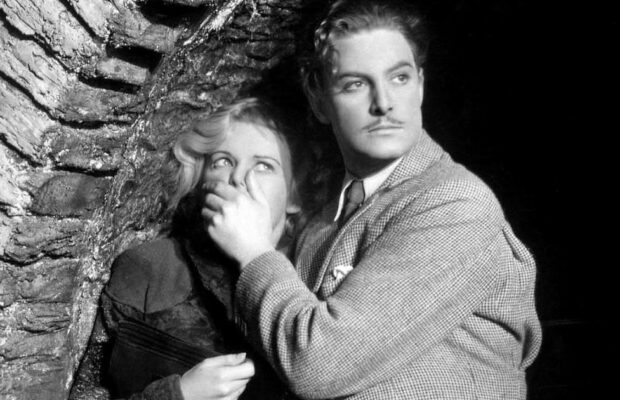
Toronto Film Society presented The 39 Steps (1935) on Saturday, June 20, 2026 as part of the Season 78 Virtual Film Buffs Screening Series, Programme 5.
Production Company: Gaumont-British Picture Corporation. Producer: Michael Balcon. Director: Alfred Hitchcock. Screenplay: Charles Bennett and Ian Hay, based on the 1915 novel The Thirty-Nine Steps by John Buchan. Cinematography: Bernard Knowles. Editor: Derek N. Twist. Music: Jack Beaver and Louis Levy. Run Time: 86 minutes. Released June 6, 1935 in the UK.
Cast: Robert Donat (Richard Hannay), Madeleine Carroll (Pamela), Lucie Mannheim (Annabella Smith), Godfrey Tearle (Professor Jordan), Peggy Ashcroft (Margaret Crofter), John Laurie (John Crofter), Helen Haye (Mrs. Louisa Jordan), Frank Cellier (Sheriff Watson), Wylie Watson (Mr. Memory).
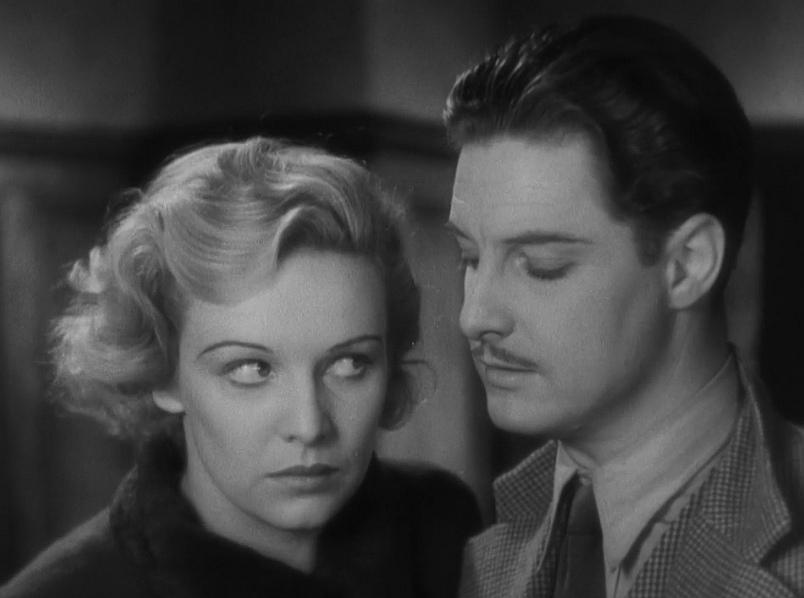
A spy-thriller about a man who isn’t a spy, The 39 Steps is Alfred Hitchcock’s 22nd movie, his second breakthrough hit in America, and was described by no less a director than Orson Welles as a masterpiece. Beloved by Hitch himself (it numbers among the at least five movies reported to have been the director’s favourite), the film would introduce or develop themes and symbols that repeated themselves again and again in Hitchcock’s future work. A regular guy is mistaken for someone he’s not, and is thus thrust into a life-or-death situation. A frosty blonde needs to be taken down a peg before she can notice that she’s in love. A plot device called a MacGuffin sets the action in motion but is otherwise completely irrelevant. A thrilling climax occurs at a real-life monument. The 39 Steps has all this, and bullet stopped by a pocket hymn book. What a movie.
Richard Hannay is a Canadian living in London when he is picked up by what he must assume to be some kind of woman of the night. She turns out to be a spy, and is promptly and inconveniently killed at Hannay’s apartment after giving him enough information for him to know that he now has a mission, but not enough information for him to know how to do it. (For someone who trades in secrets, the woman is remarkably loose lipped.)
Like so many of Hitchcock’s ‘wrong men’ who find themselves in situations for which they are neither trained nor particularly capable (Barry Kane in Saboteur (1942), Manny Balestrero in The Wrong Man (1956), Roger Thornhill in North By Northwest (1959) to name a few), Hannay rises to the occasion, evading the police in order to travel to the town in Scotland to which the late spy said she was headed next. Is there some innate heroic quality that these men share, that would have lain dormant within them had they not been tested by circumstance? Or are we all capable of climbing the outside of a train travelling at top speed to evade the police—we’ve just never had to? Personally, I hope I’ll never find out.
After a dalliance with future-Oscar-winner Peggy Ashcroft’s oppressed crofter’s wife, Hannay manages to find his way to the man he’s been seeking—only to discover that this man was not an ally, but instead the villain the spy had warned him about.
What follows is a continued chase, now from both the police and the ring of spies we will learn is called the 39 Steps. Hannay is betrayed by Pamela, a woman he can’t seem to convince he isn’t a murderer, and the two end up chained together, Hannay dragging her (literally) over hill and dale and finally into a small inn where they pose as awkward newlyweds. (It’s hard to imagine American censors allowing an unmarried man and woman to lie in bed together, with handcuffs!) It doesn’t take Pamela long to discover that Hannay’s unbelievable story is actually true, and the two of them set forth to…well, it doesn’t really matter. Such is the nature of the MacGuffin.
By 1935, when The 39 Steps premiered, Alfred Hitchcock had worked his way up in the brand-new British film industry, from designing title cards to co-writing silent features to being described as the “fat youth” who headed the props department. His first films had gained recognition within Britain, but it wasn’t until The Man Who Knew Too Much that American audiences, up to their elbows in their own talent, began to notice the auteur director from across the pond who would go on to pioneer an entire genre of cinema.
Hitchcock had read the novel The Thirty-Nine Steps as a child, as well as the other books in John Buchan’s series about a Canadian who becomes embroiled in the world of international espionage, and decided that he wanted to adapt the book for his next film project. (Ian Fleming had also read John Buchan’s novels as a child, and cited Richard Hannay as one of his inspirations for the character of James Bond.)
Gaumont-British, the studio for which Hitchcock had directed The Man Who Knew Too Much, spent triple what that movie had cost in order to make a real swing for international recognition. Much of that money went to leads Robert Donat and Madeleine Carroll, who had both already achieved success in American movies. Upon its release, The 39 Steps was a great success in both England and the U.S., and Hitchcock was praised in the New York Times as “a master of shock and suspense, of cold horror and slyly incongruous wit.” Following the success of The 39 Steps, Madeleine Carroll was offered a contract by Paramount, the first English starlet ever to have received an offer from a major Hollywood studio. Robert Donat’s performance garnered offers to star in Hitchcock’s next two films, and similar offers from MGM, Sam Goldwyn, and David O. Selznick. (He did a René Clair comedy instead.)
Alfred Hitchcock would go on to direct dozens more movies that influenced cinema history and embedded themselves in the popular consciousness. (Where would movies be without the screechy violins from Psycho (1960), or the carnival murder scene in Strangers on a Train (1951), or those ominous telephone-wire grackles in The Birds (1963)?) But The 39 Steps is not merely an early work by a director who became a genius; it is a confident, ingenious, and thrilling movie in its own right, deserving of a place in the pantheon of Hitchcock’s best films. Think of the best moments of The 39 Steps: the impromptu election speech for Mr. McCrocodile; the kiss in the railway car; the discovery of the location of the state secrets—those are moments that have stood the test of time, and mark the film as a truly enduring classic.
Notes by Ivy Johnson
You may also like...

-
Support Classic Cinema: Toronto Film Society Sponsorship Opportunities
Toronto Film Society Corporate Sponsorship 2026/27 About TFS Founded in 1948, the Toronto Film Society is one of Canada’s oldest film appreciation groups. It was originally formed to meet...
Virtual Saturday Night at the Movies
Toronto Film Society will be screening Alfred Hitchcock’s Lady Windermere’s Fan (1925) straight to your home on Tuesday, September 29, 2026 at 7:15 p.m. (ET)! Directed by Ernst Lubitsch,...


