
La Cage aux Folles (1978) and Some Like it Hot (1959)
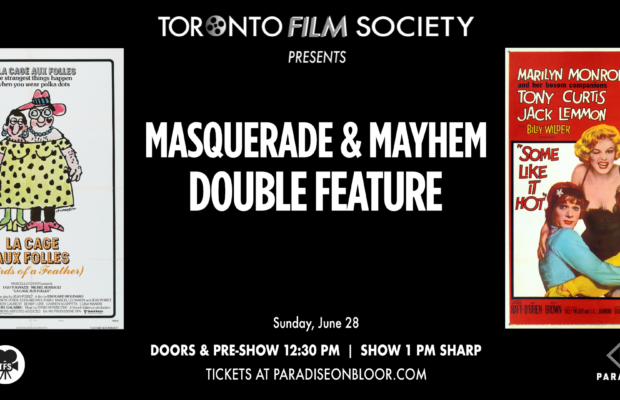
Toronto Film Society presented La Cage aux Folles (1978) on Sunday, June 28, 2026 in a double bill with Some Like it Hot (1959) as part of the Season 78 Series, Programme 8.
LA CAGE AUX FOLLES (1978)
Production Company: Les Productions Artistes Associés, Da Ma Produzione. Produced by: Marcello Danon. Director: Édouard Molinaro. Screenplay: Francis Veber, Édouard Molinaro, Marcello Danon, Jean Poiret, based on the play La Cage aux Folles by Jean Poiret. Cinematography: Armando Nannuzzi. Music: Ennio Morricone. Film Editors: Monique Isnardon, Robert Isnardon. Release Date: October 25, 1978. Running time: 96 minutes.
Cast: Ugo Tognazzi (Renato Baldi), Michel Serrault (Albin Mougeotte, a.k.a. Zaza Napoli), Claire Maurier (Simone Deblon), Rémi Laurent (Laurent Baldi), Carmen Scarpitta (Louise Charrier), Benny Luke (Jacob), Luisa Maneri (Andréa Charrier), Michel Galabru (Simon Charrier), Venantino Venantini (Charrier’s chauffeur), Carlo Reali (Bouncer), Guido Cerniglia (Doctor).
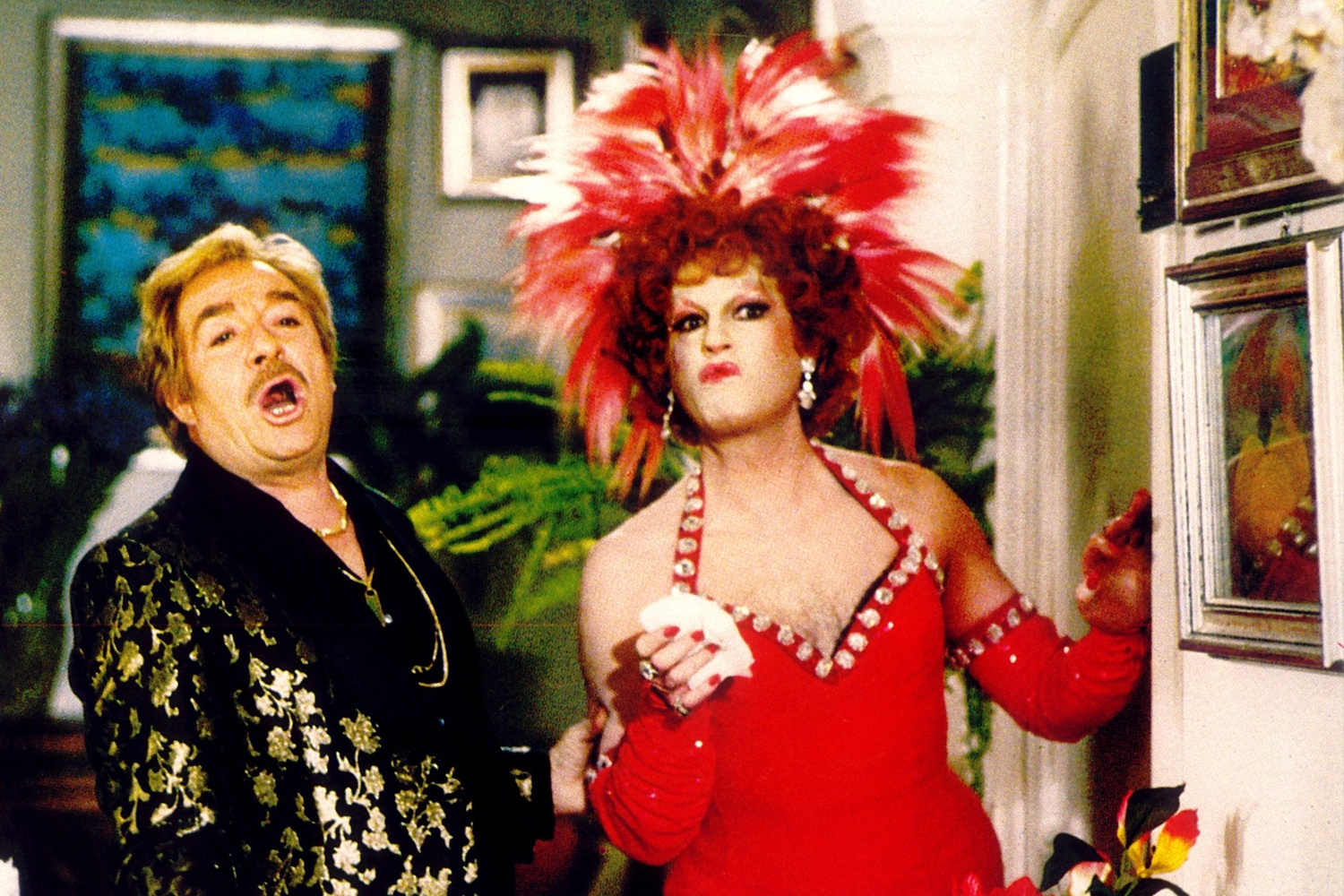
A classic French farce with a twist, Édouard Molinaro’s wildly popular 1978 film La Cage aux Folles is a groundbreaking comedy about family, identity, sacrifice, and sequins.
The action of La Cage aux Folles centres around a drag nightclub, located in the French Riviera and populated by a host of vivid characters whose personalities are bigger than even their wigs. Renato Baldi, the owner of the nightclub, handles the prima donna antics of his biggest star/romantic partner, Albin, with a seasoned equipoise that seems to be his greatest managerial asset. Their relationship is far from harmonious, but the constant bickering is undergirded with genuine affection – they’re like Archie and Edith Bunker, if Edith had been a drag queen and Archie’s interior design aesthetic had tended heavily towards the phallic.
When Renato’s son from his previous marriage arrives with the news that he’s getting married to the daughter of an ultraconservative politician, Renato is forced to find a way to play straight for his son’s future in-laws, resulting in misguided disguises, failed ruses, a truly infelicitous redecoration, and a memorable dinner party at which both the son’s mothers make an appearance.
The film is based on a play of the same name, which was written by Jean Poirot, as a vehicle for himself and his frequent collaborator, Michel Serrault. An extremely popular stage run resulted in a movie deal. While Poirot was replaced by a bigger-name star (Italian comedy actor Ugo Tognazzi), Serrault reprised his stage role in the film.
La Cage aux Folles was a huge commercial success, spawning two sequels and a 1996 American remake called The Birdcage, directed by Mike Nichols and adapted by Elaine May. Translations of La Cage aux Folles have been performed all over the world – in Canada alone there have been two recent notable runs, one at the Stratford Theatre Festival in 2024 and one Quebec retranslation that is currently touring that province. In 1983, it was reimagined as a musical, to great critical acclaim; Harvey Fierstein, best known for playing Edna Turnblad in the original Broadway run of Hairspray, won a Tony for writing it.
But what drew worldwide audiences in, back in 1978? And what makes this story so enduring that we are still watching it almost fifty years later?
La Cage aux Folles was groundbreaking in its time for its portrayal of a long-term gay relationship that, while occasionally played for laughs, also comes across as loving, committed, and real. Emerging at a moment of high political tension over gay rights (it was released less than a decade after the Stonewall riots in New York City), it also served to normalize queer relationships and drag performance for mainstream audiences. As Roger Ebert wrote at the time, La Cage aux Folles is about “people who are good-hearted, who mean well, and who cannot help being true to their natures. It is also slapstick, farce, wicked social satire, lachrymose soap opera, and, sneaking in here and there, even a few plausible human truths.” The movie was the highest grossing foreign film ever released in America, and was nominated for three Academy Awards, including Best Director, Best Adapted Screenplay, and Best Costume Design.
Though the reception was widely positive (and remains so – La Cage aux Folles has a Rotten Tomatoes score of 92%), there was also criticism at the time of the film’s release. Some members of the queer community noted that it relied heavily on stereotypes. Echoing these sentiments, Vincent Canby of the New York Times described La Cage aux Folles as “naughty in the way of comedies that pretend to be sophisticated but actually serve to reinforce the most popular conventions and most witless stereotypes.”
To today’s audiences, La Cage aux Folles may seem dated in its depiction of gay relationships and drag culture. But its impact on society is undeniable, as is its continued resonance. At its core, this is a movie about a couple who fight intolerance with equanimity and empathy. And also sequins.
Film notes by Ivy Johnson
SOME LIKE IT HOT (1959)
Production Company: Ashton Productions, The Mirisch Company. Produced by: Billy Wilder. Director: Billy Wilder. Screenplay: Billy Wilder, I.A.L. Diamond, based on the 1935 film Fanfare of Love, by Max Bronnet, Michael Logan, Pierre Prévert, and René Pujol. Cinematography: Charles Lang Jr. Music: Adolph Deutsch. Film Editor: Arthur P. Schmidt. Release Date: March 19, 1959. Running time: 121 minutes.
Cast: Marilyn Monroe (Sugar Kane Kowalczyk), Tony Curtis (Joe/Josephine/Shell Oil Junior), Jack Lemmon (Jerry/Daphne), George Raft (Spats Colombo), Pat O’Brien (Detective Mulligan), Joe E. Brown (Osgood Fielding III), Nehemiah Persoff (Little Bonaparte), Joan Shawlee (Sweet Sue), Billy Gray (Sig Poliakoff), George E. Stone (Toothpick Charlie), Dave Barry (Beinstock), Mike Mazurki (Spats’ Henchman), Beverly Wills (Dolores), Barbara Drew (Nellie), Edward G. Robinson Jr. (Johnny Paradise).
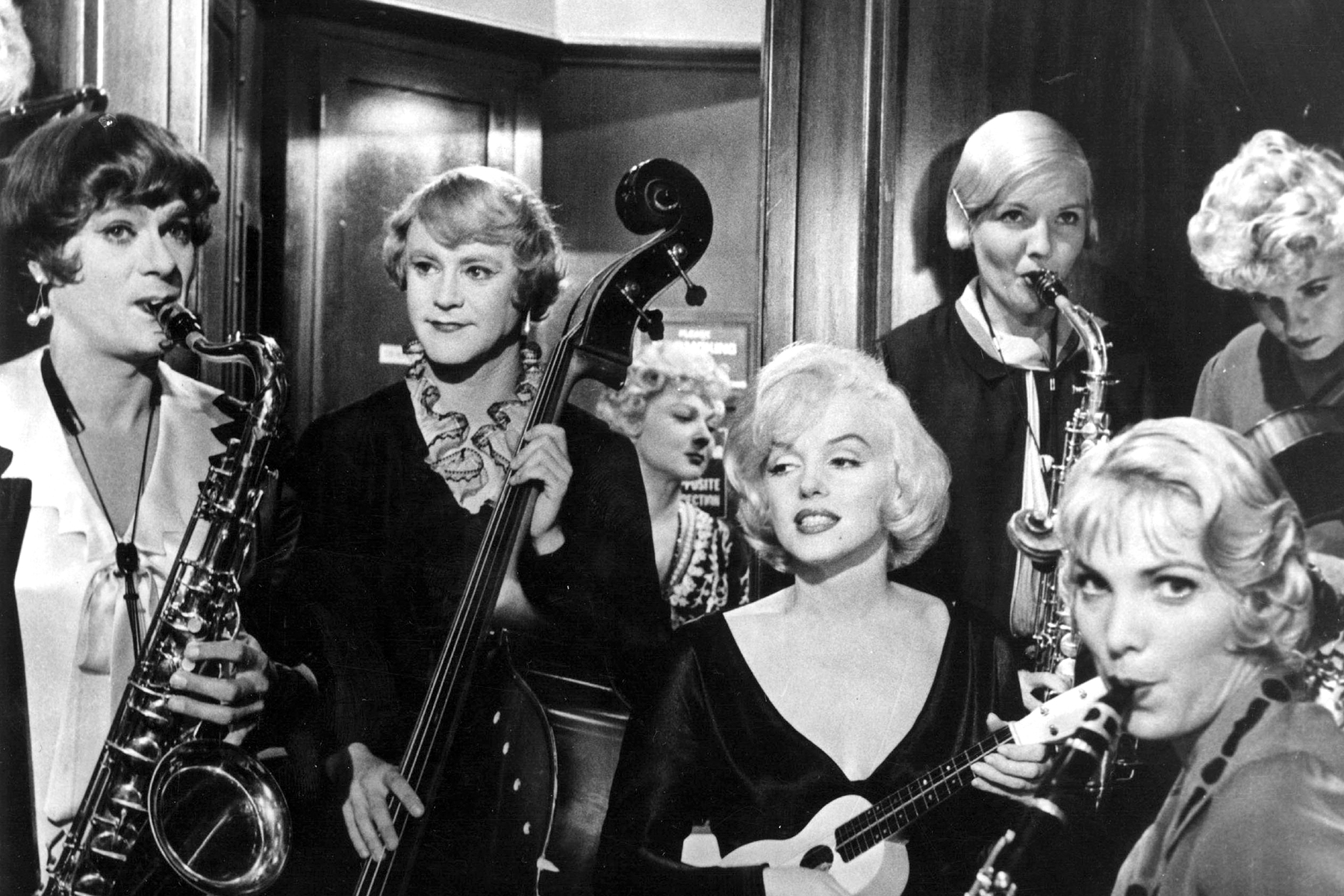
Two down-on-their-luck jazz musicians, Joe (Tony Curtis) and Jerry (Jack Lemmon), accidentally witness a mob-hit, based on the 1929 St. Valentine’s Day Massacre in Chicago. Desperate to escape the wrath of mob boss “Spats” Colombo (George Raft), they disguise themselves as women – “Josephine” and “Daphne” – and join an all-female jazz band traveling to Miami to work at a swanky resort. While incognito, the men find fun and laughter with the ladies of the band. Joe is smitten with the lead singer, Sugar Kane (Marilyn Monroe), and tries to win her love, while Daphne has to deal with the fresh advances of an eccentric millionaire – zowee!
By 1958, director Billy Wilder, was a well-respected Academy Award winning writer and director of a string of hits dating back to the 1940s, including Double Indemnity (1944), The Lost Weekend (1945), Sunset Boulevard (1950), Stalag 17 (1953), and Sabrina (1954). In 1955, Wilder directed Marilyn Monroe for the first time in The Seven Year Itch and, though he loved her beauty and performances, she was quite a handful.
“All right, Mr. DeMille, I’m ready for my close-up.”
Marilyn found it difficult to work unless she was absolutely ready, making the cast and crew to wait hours. When Marilyn was finally ready to work, it often took dozens and dozens of takes before she could get the scene right. It took 47 takes to deliver the line “It’s me, Sugar.” Sometimes she said, “Sugar, it’s me” or “It’s Sugar, me”…47 times! It was reported that “Where’s that bourbon?” took somewhere between 40 to 60 takes until finally Wilder had the line dubbed in at a point in the scene where her back is to the camera. After Some Like it Hot, he described working with Marilyn: “I worked on two pictures with her and wanted to give up the profession….My wife and three doctors begged me to never work with her again. She was a most difficult woman…”
Marilyn was known to be emotionally fragile and troubled with addiction; Tony Curtis described her as ‘needy and neurotic’. On set, she leaned heavily for emotional support from her acting coach, Paula “the Bat Lady” Strasberg…a severe woman described as “looking like Dracula’s assistant due to her habitual wearing of black capes.” Marilyn would look to Paula for approval after every single shot, instead of the director, Billy Wilder, much to his annoyance. Finally, in the middle of a scene, a frustrated Wilder called “Cut!”, and, in front of everyone, he mockingly turned to Paula and said, “How was that for you, Paula?”
“I am big. It’s the pictures that got small.”
The premise of Some Like It Hot was loosely based on a 1951 German comedy called Fanfaren der Liebe (Fanfares of Love) about two unemployed musicians who, desperate to get work, dress up as women to work in an all-female orchestra; Wilder bought the rights to the film. He originally wanted Tony Curtis and Jack Lemmon to play the boys and he signed up Tony to the project first. The money people backing the film didn’t feel Jack Lemmon was enough of a star for this film, despite his 1955 Oscar for Best Supporting Actor in Mister Roberts (1955). They wanted at least one BIG star…they wanted Frank Sinatra. So Wilder made a lunch date with Frankie; Frankie stood him up and that was that. Later, when Marilyn reached out to work with Wilder, the backers became happy, and Jack was suddenly a big enough star.
“…I think this is the beginning of a beautiful friendship”
When Billy Wilder asked Jack Lemmon to play Jerry, Jack thought about it for two seconds and said, Yes! He knew Billy would then write the part with Jack in mind. In reading the first 60 pages of the unfinished script, Lemmon said, “I thought I was gonna split a gut. I was laughing out loud; I fell off the couch at one point…I really did…” Jack Lemmon and Billy Wilder went on to make 7 more films together from 1960 to 1981. Three of those films paired Jack Lemmon with Walter Matthau and two with Shirley MacLaine. Four of the Wilder and Lemmon films were Academy Award winners and nominees. The Apartment (1960) had 5 wins out of 10 nominations, including Best Picture, Best Director for Wilder, and Best Original Screenplay for Wilder and writing partner I.A.L .Diamond. Lemmon was nominated for best actor but lost to Charlton Heston (Ben Hur). The working relationship became a true friendship between Lemmon and Wilder, with Wilder fondly saying, “Lemmon had to be an actor. I doubt he could have done anything else, except play piano in a whorehouse.”
“I don’t mind living in a man’s world, as long as I can be a woman in it.“
Marilyn Monroe’s contract stipulated that all of her movies had to be filmed in colour, but Wilder knew the appearance of Tony and Jack in dresses with all that makeup would be less jarring if the film was in black and white. At first unconvinced, the screen tests proved that he was right. The beautiful dresses and costumes make the film still feel rich, even without colour. Designer Orry-Kelly at first made only Marilyn’s dresses. The boys were sent to the wardrobe department for their clothing, but none of the existing outfits worked on their…shall we say…rather boxy figures. Tony had the idea to get Orry-Kelly to make their dresses too, and, oh my! Not as stunning a fit as Marilyn, but lovely outfits. During one fitting, Orry-Kelly said to Marilyn, “Tony has a better ass than you,” to which Marilyn opened her blouse and said, “he doesn’t have tits like these!”
It was a tough go for Tony and Jack to play women and it took lots of work and hours in make-up. During his transition to Daphne, Jack Lemmon realized that, with his hairdo and bee-sting lips, he became a bad imitation of his own mother. Tony felt awkward and clumsy, which made him act very prim and proper, giving an appearance of being aloof. If Tony sounds familiar as the suave millionaire, remember that Tony Curtis had just worked with Cary Grant in Operation Petticoat that same year and Tony was a big fan of Grant. When Some Like it Hot was in the can, Billy Wilder showed the film to Cary Grant who said, “I don’t talk like that!” and took some umbrage from it.
“…to boldly go where no man has gone before”
In Some Like it Hot, the fiddle player ‘Rosella’ in Sweet Sue and her Society Syncopators band was played by Grace Lee Whitney. For all the Star Trek fans out there, in 1966 Grace (then age 36) played the iconic role of Yeoman Janice Rand, a love interest for Captain James T. Kirk, played by Canada’s own William Shatner. Grace was fired after the first season of the original series because the network felt a steady girlfriend hindered Kirk as a romantic lead, or what many now see as a galaxy-galloping womanizer…but “Well, nobody’s perfect!“
Notes by Bruce and Carol Whittaker
You may also like...


-

Support Classic Cinema: Toronto Film Society Sponsorship Opportunities
Toronto Film Society Corporate Sponsorship 2026/27 About TFS Founded in 1948, the Toronto Film Society is one of Canada’s oldest film appreciation groups. It was originally formed to meet...
Virtual Saturday Night at the Movies
Toronto Film Society will be screening Alfred Hitchcock’s Lady Windermere’s Fan (1925) straight to your home on Tuesday, September 29, 2026 at 7:15 p.m. (ET)! Directed by Ernst Lubitsch,...


