
Lola (1961) and The Umbrellas of Cherbourg (1964)
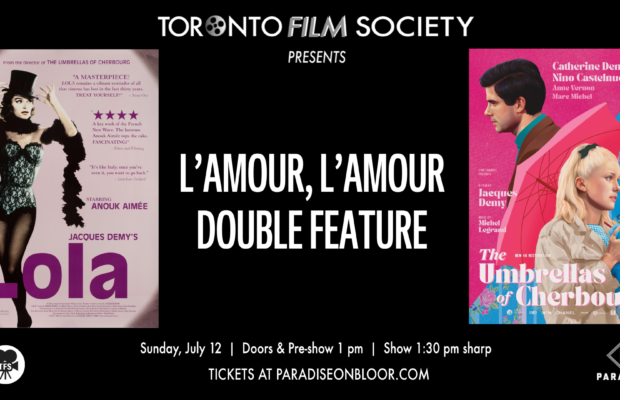
Toronto Film Society presented Lola (1961) on Sunday, July 12, 2026 in a double bill with The Umbrellas of Cherbourg (1964) as part of the Season 78 Series, Programme 9.
LOLA (1961)
Production Company: Rome-Paris Films, Carlo Ponto Production. Produced By: Carlo Ponti, Georges de Beauregard. Directed: Jacques Demy. Screenplay: Jacques Demy. Cinematography: Raoul Coutard. Music: Michel Legrand. Film Editor: Anne-Marie Cotret. Release Date: March 3, 1961. Running Time: 90 minutes.
Cast: Anouk Aimée (Lola, Cécile), Marc Michel (Roland Cassard), Jacques Harden (Michel), Alan Scott (Frankie), Élina Labourdette (Madame Desnoyers), Margo Lion (Jeanne, la mère de Michel), Annie Duperoux (Cécile Desnoyers), Corinne Marchand (Daisy).
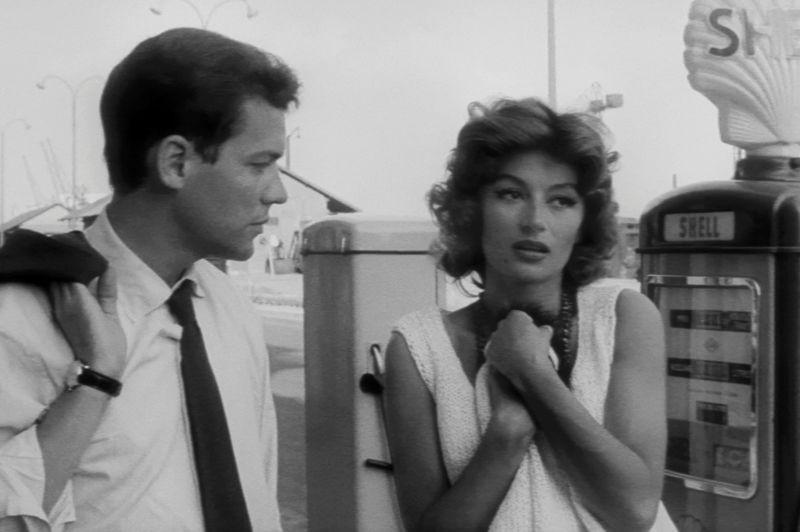
Lola is the directorial debut from Jacques Demy. Lola introduced audiences to a filmmaker who would blend the spontaneous energy of the French New Wave with the romanticism of old Hollywood musicals. Described by Demy as a “musical without music”, Lola is filled with rhythm, yearning, and affection, shot through in beautiful black and white by Raoul Coutard. Lola uses Jacques Demy’s recurring themes of coincidence and longing with Michel Legrand’s score to create a world that Demy continued to explore throughout his career.
The film follows Roland Cassard, a free-spirited young man in the city of Nantes, who is unsure of what to do with his life. Through pure coincidence, Roland reconnects with Lola, a cabaret dancer and single mother he loved from his past. While Roland thinks he has found what he has been missing in his life, Lola is still devoted to Michel, a man who left her before the birth of their child.
This is one of the many films in which Demy shows his fascination with the coincidence and timing that play a part in our lives without feeling the need to be cynical. Characters narrowly miss each other, and old relationships remain alive inside of their minds, constantly thinking of what could have been. His characters make decisions in their lives through pure feelings and what feels right to them. Almost all the characters yearn for something that is beyond what is currently possible for them, lost romance, better future, or even a different life entirely.
Lola represents an important collaboration among several pivotal figures in French New Wave cinema. This film was shot by cinematographer Raoul Coutard, who was behind the camera for many of the most pivotal films of the French New Wave, often collaborating with Jean-Luc Godard and François Truffaut. Coutard is renowned for his ability to shoot the city streets and cafés of Nantes with the realism of a documentary while keeping a cinematic visual style. This was also the first time Jacques Demy connected with composer Michel Legrand; they would later dive deeper with the music, by making musicals like The Umbrellas of Cherbourg and The Young Girls of Rochefort.
The film also launches Demy’s tiny interconnected cinematic universe, much smaller than the universes that audiences are accustomed to today. Roland shows up in The Umbrellas of Cherbourg in 1964 and Lola makes a return in the film Model Shop in 1969. Not only was this a big film for Demy, it also started one of the best runs of movies an actress has ever had.
Just one year before Lola, Anouk Aimée appeared in Federico Fellini’s La Dolce Vita (1960). Within the same decade, she would go on to star in Fellini’s 8½ (1963), widely regarded as one of the greatest films ever made, as well as the Palme d’Or-winning A Man and a Woman (1966) and Jacques Demy’s Model Shop (1969). It was an extraordinary run that helped cement Aimée as one of cinema’s most iconic actresses.
Sixty-five years later after Lola was released, it is considered a masterpiece and one of Demy’s finest achievements. Lola has also been cited as a huge inspiration to filmmakers like Richard Linklater and Wong Kar-Wai who have carried the torch of Demy’s style and echo his themes of romantic longing. The elegant and deeply humane Lola, is the perfect introduction to one of cinema’s great romantics.
Film Notes by Brandon Lalljee
THE UMBRELLAS OF CHERBOURG (1964)
Production Companies: Parc Film, Madeleine Films and Beta Film. Producer: Mag Bodard. Director: Jacques Demy. Screenplay and Lyrics: Jacques Demy. Cinematography: Jean Rabier. Editor: Anne-Marie Cotret and Monique Teisseire. Production Design: Bernard Evein. Costume Design: Jacqueline Moreau. Music: Michel Legrand. 92 minutes. Released February 19, 1964 in France.
Cast: Catherine Deneuve (Geneviève Emery), Nino Castelnuovo (Guy Foucher), Anne Vernon (Madame Emery), Marc Michel (Roland Cassard), Ellen Farner (Madeleine), Mireille Perrey (Aunt Élise), Jean Champion (Aubin), Pierre Caden (Bernard), Jean-Pierre Dorat (Jean).
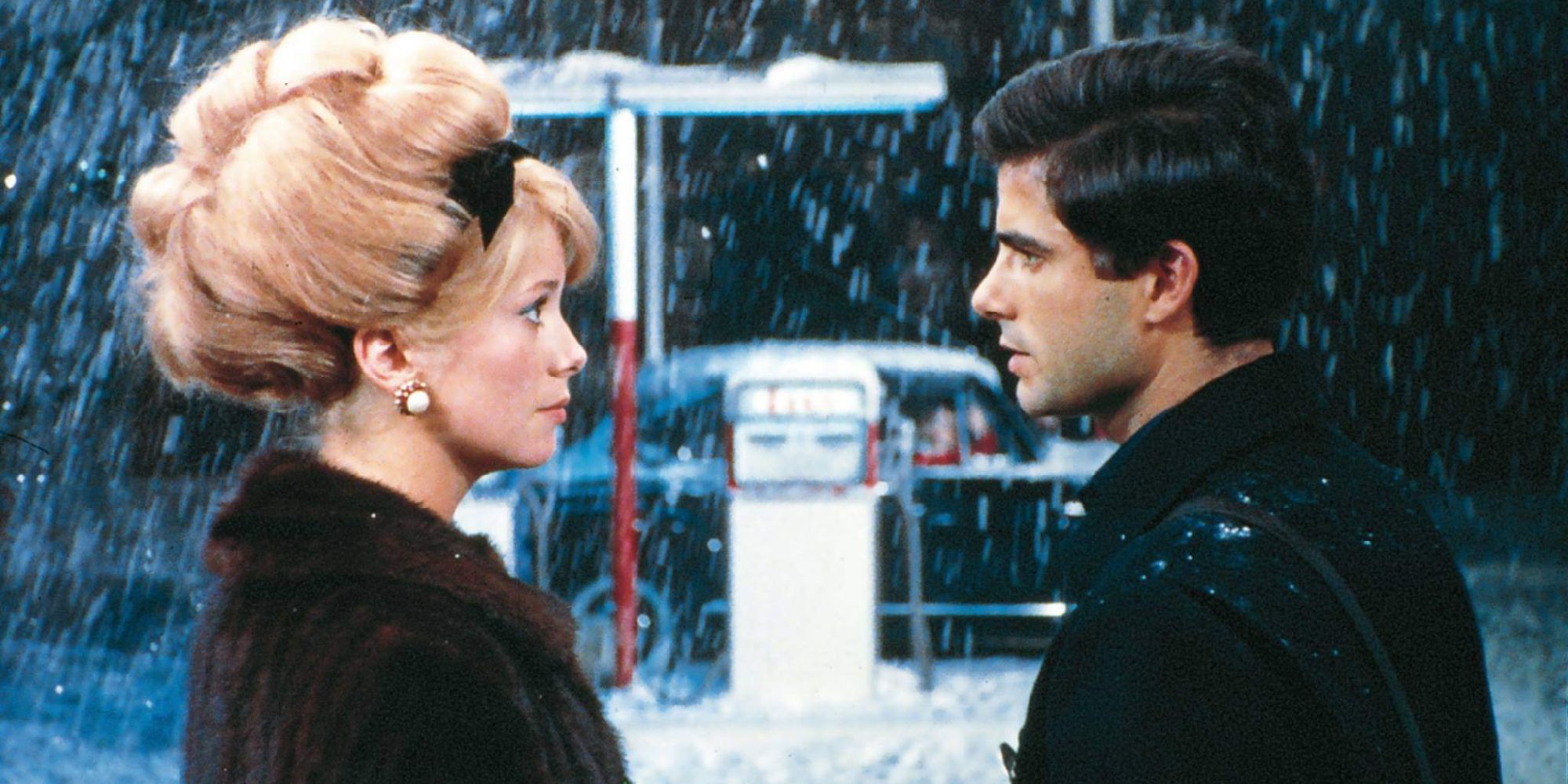
The Umbrellas of Cherbourg, a bittersweet and realistic portrayal of first love, is visionary director Jacques Demy’s magnum opus, nominated for 5 Academy Awards and winning the Palme D’Or at the Cannes Film Festival.
On the surface this is a musical about teenage romance in a provincial French town. Demy employs signature elements including vibrant colours and an entirely “sung through” dialogue, a style he pioneered, against a backdrop of orchestral music (he felt spoken dialogue alternating with singing and dancing in traditional musicals made the story disjointed). Look past the whimsical style, however, and you will see a story about how life can interrupt young love with military service, maternal interference, and a need to adhere to social conventions.
Umbrellas sees the emergence of Demy’s trademark visual style with its saturated colours (the wallpaper alone is a vibrant feast for the eyes!). In addition to directing, Demy wrote the screenplay and lyrics for the film with the rich, melodic score composed by frequent collaborator Michel Legrand. H
is cinematic style was influenced by Hollywood musicals and fairytales which set him apart from his New Wave (Nouvelle Vague) counterparts like Jean-Luc Godard and Francois Truffaut who favoured gritty realism, political agitation, and stark aesthetics (though he did follow the New Wave edict of filming on location, avoiding studio shots). Demy and his wife, Agnes Varda, a celebrated filmmaker in her own right, were both foundational members of the New Wave sub-faction, the Left Bank (Rive Gauche). The Left Bank directors were older, deeply interested in the arts and literature, and highly focused on politics, memory, and poetry.
Umbrellas was the breakout film for Catherine Deneuve (Genevieve), just 19 years old when filming began, and she attributes it to catapulting her into international stardom and a career spanning 60+ years and counting. While she described the “sing through” experience as both magical and intense, she and all other cast members vocals, were actually dubbed by professional vocalists.
This was the first of four films in which Demy cast Deneuve, followed by The Young Girls of Rochefort (1967), Donkey Skin (1970), and A Slightly Pregnant Man (1973). Italian actor Nico Castelnuovo (Guy), in a case of life imitating art, was a mechanic before he studied acting in Milan. He didn’t find success in subsequent films and ended up featuring primarily in European television serials following Umbrellas. This film is the second appearance of Roland, played by Marcus Michel, who references his past love in Lola (1961) to Madame Emery, Genevieve’s mother, played by veteran French film actress, Anne Vernon).
Widely considered one of the more exceptional film final scenes, Demy shies away from a happy ending and opts for a realistic encounter of the one-time lovers after many years, a situation more plausible to viewers than a joyful reunion. The closing gas station scene may seem familiar to those who have seen Damien Chazelle’s 2016 film La La Land. A love story thwarted by success against a saturated primary colour palette, La La Land pays homage to the emotional and visual aesthetic of Umbrellas throughout. Greta Gerwig’s Barbie (2023) also draws heavily from Demy’s vibrant, hyper-stylized colouration and outfit coordination.
The Umbrellas of Cherbourg endures because of, not in spite of, rejecting the Hollywood cliche that true love conquers all. As Madame Emery says, “people only die of love in the movies”. Often, when fairytale romances are interrupted by heartbreaking reality, life simply goes on.
Film notes by Kathleen McLarty
You may also like...
-
Support Classic Cinema: Toronto Film Society Sponsorship Opportunities
Toronto Film Society Corporate Sponsorship 2026/27 About TFS Founded in 1948, the Toronto Film Society is one of Canada’s oldest film appreciation groups. It was originally formed to meet...
Virtual Saturday Night at the Movies
Toronto Film Society will be screening Alfred Hitchcock’s Lady Windermere’s Fan (1925) straight to your home on Tuesday, September 29, 2026 at 7:15 p.m. (ET)! Directed by Ernst Lubitsch,...


