
The Awful Truth (1937) and My Favorite Wife (1940)
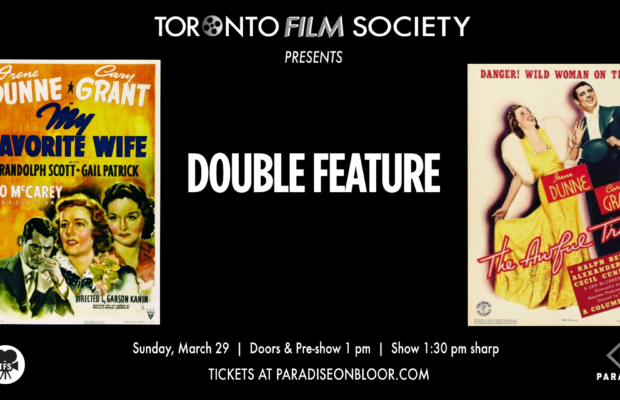
Toronto Film Society presented The Awful Truth (1937) on Sunday, March 29, 2026 in a double bill with My Favorite Wife (1940) as part of the Season 78 Series, Programme 5.
THE AWFUL TRUTH (1937)
Production Company: Columbia Pictures. Producer: Leo McCarey. Director: Leo McCarey. Screenplay: Viña Delmar. Based on The Awful Truth, 1922 play by Arthur Richman. Cinematographer: Joseph Walker. Editor: Al Clark. Running Time: 91 minutes. Released: October 21, 1937.
Cast: Irene Dunne (Lucy Warriner), Cary Grant (Jerry Wariner), Ralph Bellamy (Daniel Leeson), Alexander D’Arcy (Armande Duvalle), Cecil Cunningham (Aunt Patsy).
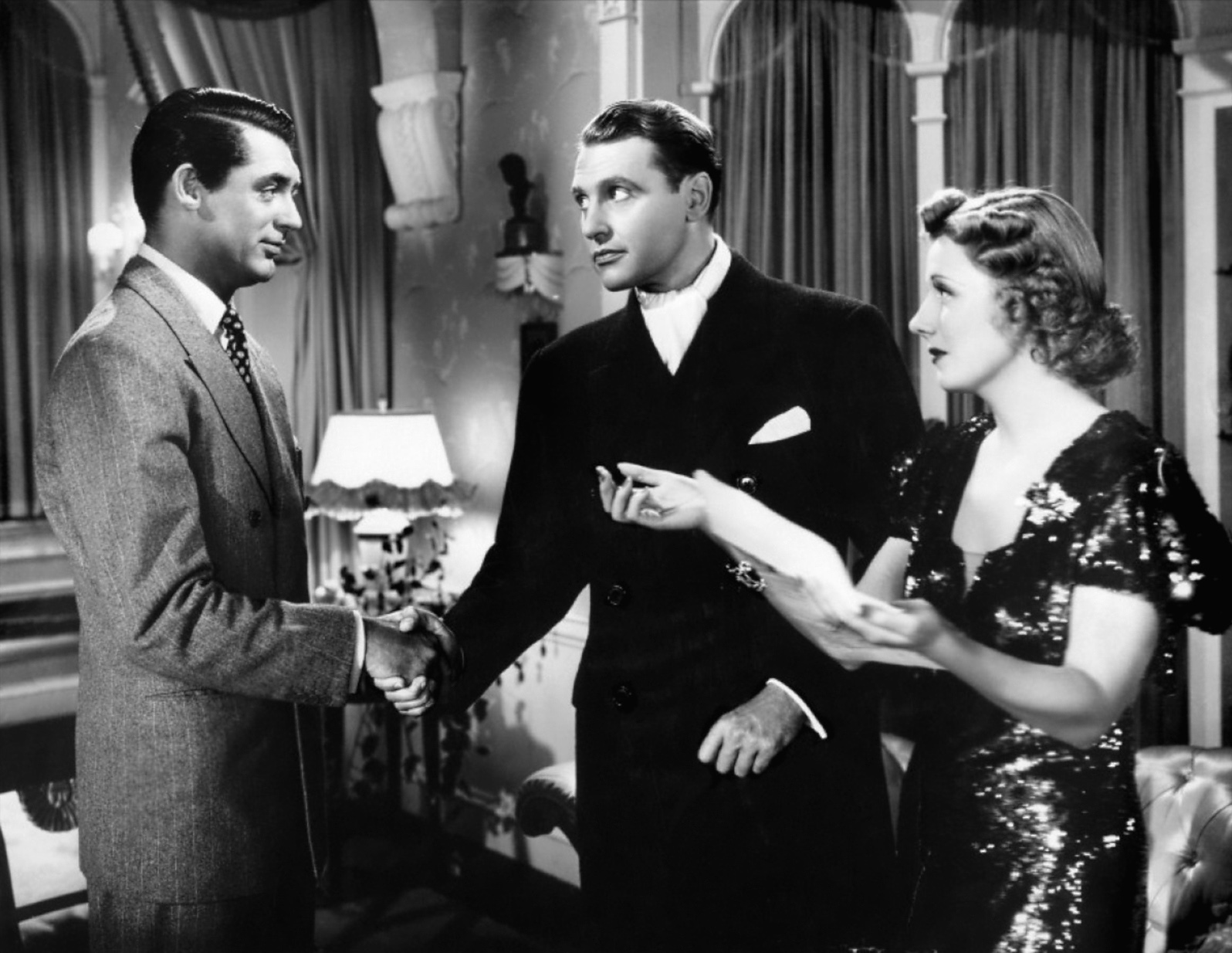
Under mutual suspicions of infidelity, a wealthy couple head for divorce, except…they’re not ready to let each other, or Mr. Smith, go. Another screwball comedy ensues. The lead actors, Cary Grant, Irene Dunne, and Ralph Bellamy, are joined by a talented supporting cast, to say nothing of the dog…
Cary Grant and Irene Dunne made three films together: The Awful Truth (1937), My Favorite Wife (1940), and Penny Serenade (1941). Grant and Ralph Bellamy made two films together, The Awful Truth and His Girl Friday (1940).
Ralph Bellamy’s role in The Awful Truth is very similar to that in His Girl Friday where he plays a gormless lug with a good heart and an overprotective mother. In both films he is subjected to Cary Grant’s veiled insults and innuendos. At 6 ft, Bellamy proves to be quite the dancer in this film. In a nightclub scene, he danced the fictional “Balboa Stomp” while Irene Dunne struggles to keep up. The dancing was so demanding on him that Bellamy said he lost 15 pounds and suffered with sore muscles and joints for weeks afterwards. Dedication! That’s one way to get an Oscar nomination, but unfortunately, no Oscar for him this time.
As with many films of the era and genre, the sets feature opulent apartments and homes while the actors are impeccably dressed. Miss Dunne’s wardrobe was created by Columbia Studios chief costume and fashion designer Robert Kalloch. The wardrobe is widely regarded as being one of the best of the era. It was described as “magnificent” by costume design historian Jay Jorgenson. Vanity Fair magazine ranked The Awful Truth as one of the 25 most fashionable films ever made in Hollywood. Kalloch was known to be extraordinarily devoted to his mother and cared for her most of his life. Around 1931, he met his partner, Joseph Demarais, the son of French-Canadian immigrants; they lived together until, coincidentally, the couple died on the same day, each of natural causes.
The Awful Truth was director Leo McCarey’s first film for Columbia Pictures; they were probably happy as McCarey won the Best Director Oscar for this film. Although McCarey relied heavily on dialogue written by Sidney Buchman, who remained uncredited in the film, much of the films best dialogue and antics were improvised.
One plot contrivance of the film includes Grant and Dunne in divorce court, each seeking custody of their dog, Mr. Smith; his real name was Skippy, a wire-haired Fox Terrier familiar to many as Asta in three Thin Man films. Another appearance by Skippy was in Bringing Up Baby as that bone stealing rogue, George, the pup belonging to Katharine Hepburn’s Aunt Elizabeth (May Robson).
In all, Skippy appeared in 24 films from 1932 to 1947, supporting the likes of Edward G. Robinson, Sylvia Sidney, Frederick March and Bette Davis. He was said to be one of the most intelligent of animal stars then working in movies. Skippy could respond to both verbal commands and hand cues, all essential for a performing dog on a sound stage. His training began when he was three months old, and he made his first professional film appearances at the age of one year, in 1932–33. Skippy was trained by his owners, Henry and Gale East, along with animal trainers Frank Inn, and brothers, Frank and Rudd Weatherwax. The Weatherwax brothers owned other dogs including the dog who played Old Yeller and a number of collies who portrayed Lassie in films and on television.
Frank Inn was a successful animal owner and trainer for the movies and television. He trained everything from dogs and cats to chimpanzees. Some of his best known ‘employees’ (so to speak) were: Arnold the pig from Green Acres; his cat Orangey in Rhubarb (1952), Breakfast at Tiffany’s (1961), and The Incredible Shrinking Man (1957). Inn also trained a lion used in episodes of TV’s The Addams Family, a show that coincidentally had Rudd Weatherwax’s nephew, Ken Weatherwax star as the freckled and chubby Pugsley Addams.
Frank Inn’s corral of trained actors made up many of Elly May Clampett’s “critters” on The Beverly Hillbillies. However, his most famous dog is perhaps Higgins, who played the loveable mutt in Petticoat Junction and also Benji in the movie of the same name. Brace yourself for a cute picture. Here it comes… awwwwwwww!
Notes by Bruce Whittaker
MY FAVORITE WIFE (1940)
Production Company: RKO Radio Pictures. Producer: Leo McCarey. Director: Garson Kainin. Screenplay: Bella Spewack and Samuel Spewack, story by Leo McCarey, Bella Spewack, Samuel Spewack. Cinematography: Rudolph Maté. Film Editor: Robert Wise. Music: Roy Webb. Release Date: May 17, 1940. Running Time: 88 minutes.
Cast: Cary Grant (Nick Arden), Irene Dune (Ellen Wagstaff Arden), Randolph Scott (Stephen Burkett), Gail Patrick (Bianca Bates), Ann Shoemaker (Ma Arden), Corky the Dog (Uncredited).
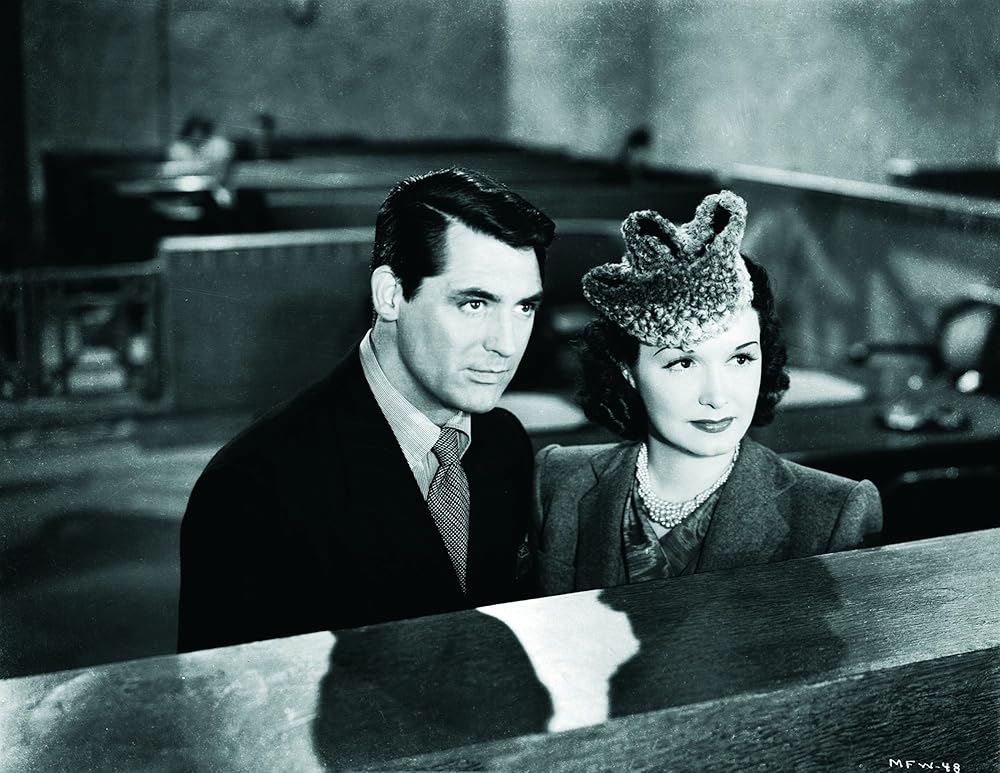
Following The Awful Truth, and subsequent successful “screwball comedies” including Bringing Up Baby, Holiday (both from 1938), and His Girl Friday (1940), Cary Grant reunited with director Leo McCarey and co-star Irene Dunne for My Favorite Wife. The film opens in a courtroom with a judge (Granville Banks) considering Nick’s (Grant) request to have his wife, who’s been missing at sea for 7 years, pronounced dead and to subsequently preside over Nick and Bianca (Gail Patrick), his new fiancée’s, wedding. In a stroke of coincidence, wife number one, Ellen (Dunne), shows up alive the very afternoon of the wedding (and prior to the marriage being consummated, much to the relief of Hays Code censors). But just when it looks like Nick and Ellen will reunite, Nick finds out Ellen (Eve) spent the 7 missing years on an island with Steve “Adam” Burkett (Randolph Scott).
My Favorite Wife is one of four films that are loose adaptations of Alfred Lord Tennyson’s 1864 poem Enoch Arden (in fact, Nick’s last name, family name, is a nod to the poem’s title). Something’s Got to Give (1962) was meant to be a remake, but filming stopped due to Marilyn Monroe’s untimely death and Dean Martin pulling out of the production when Monroe was to be replaced by Lee Remick. Some of the sets built for this production were later repurposed for Move Over, Darling (1963), a direct remake of My Favorite Wife starring Doris Day and James Garner. Finally, The Parent Trap (1998) features the most famous homage to the original with a replica scene in which Nick (Dennis Quaid), upon seeing his former wife Elizabeth (Natasha Richardson) at a hotel while he is with his new fiancée, leans against the elevator wall in shock as the doors close.
Just as filming was due to begin, Leo McCarey was involved in a serious car accident on the way home from a location shoot for a Charles Laughton picture in the San Bernardino mountains. He and colleague Gene Fowler were pinned under a vehicle for 15 minutes and almost drowned in gasoline. McCarey was replaced by Garson Kanin as director but stayed on as producer. Gail Patrick commented that the cast and crew found it difficult to maintain the comedic spirit on set as they worried about their colleague’s condition; however, McCarey made a full recovery and ended up working with Grant again on Once Upon a Honeymoon (1942) and An Affair to Remember (1957).
By all accounts, Grant and Dunne thoroughly enjoyed working together. According to Dunne, Grant said she had perfect comedic timing and was the “sweetest smelling actress he’d ever worked with”. In both The Awful Truth and My Favorite Wife, Dunne proves herself a worthy match for Grant with quick-witted dialogue and physical comedy. She has been referred to by some as the best female star of the Golden Age of film never to win an Oscar. The duo reprised their chemistry one more time in 1941, taking a more dramatic turn in the film Penny Serenade.
In addition to the lead roles, the supporting cast delivered memorable performances in My Favorite Wife. The role of Bianca was not a stretch for Gail Patrick, who was known for playing the beautiful but cold sophisticates in contrast to more likeable but equally beautiful leading ladies. Patrick, having studied law for two years, actually helped write the courtroom dialogue in the film and, following her retirement from acting in 1948, went on to executive produce the Perry Mason television show from 1957-1966. Randolph Scott, who is remembered most for his Western era films in the latter half of his career, is memorable as the upper-class, athletic vegetarian Burkett. Grant and Scott were roommates at the time of filming, a 10-year on-and-off arrangement that sparked much speculation about their relationship. Modern viewers of My Favorite Wife have suggested many scenes, including Nick’s reaction to Steven’s prowess in the pool, reference to Steve staying at the YMCA, and Nick rushing out to find Steven in a leopard-print robe, are “gay coded”; however, nothing more than a long-term friendship between the actors has ever been confirmed.
Chester Clute has a hilarious cameo as the shoe salesman Ellen pays to pretend to be Burkett and Granville Bates bookmarks the film as the Judge Bryson. When previews didn’t land well with audiences, McCarey wrote the closing courtroom scene allowing for another humorous encounter with Judge Bryson, which saved the film. Scotty Beckett, known for being the littlest member of “Our Gang” and who worked with some of the era’s biggest names including Spencer Tracy, Greta Garbo, Norma Shearer, Errol Flynn, and Fredric March, was cast as Nick and Ellen’s son, Tim. Sadly, Scotty battled alcoholism, gambling addiction, and substance abuse which led to arrests and eventually a serious car accident where he was severely disabled. He died at the age of 38, after he attempted suicide for a second time.
My Favorite Wife was nominated for Best Writing, Best Art Direction, and Best Music at the 1941 Academy Awards. It is ranked as one of the top 100 American Film Institute American movies and was the second most successful RKO film in 1940. Though it may not top your list of Cary Grant movies, we trust once you’ve watched My Favorite Wife you’ll say, as Bianca did when she paid the judge $25 after punching Nick in the nose, “It was worth it!”.
Notes by Kathleen McLarty
You may also like...
-

Thank You from TFS!
Our matinée on Sunday, August 17th – at the blessedly air conditioned Paradise Theatre – will conclude the Toronto Film Society’s 77th season! But take heart, as we’ll be...

Sunday Afternoons at the Paradise
Join TFS for Season 78’s Sunday Matinée Series generously sponsored by our good friend, author and documentary filmmaker, Mr. Don Hutchison. Please save this date and visit us regularly...


