
Golden Earrings (1947) and Kitty (1945)
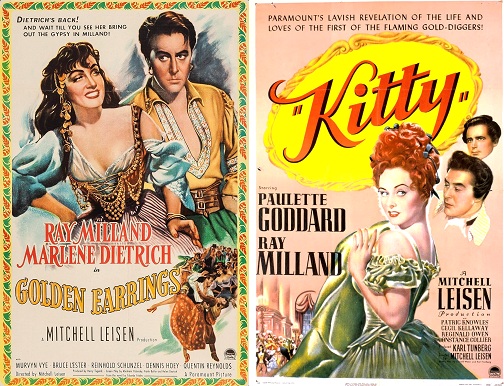
Toronto Film Society presented Golden Earrings (1947) on Monday, August 18, 1986 in a double bill with Kitty (1945) as part of the Season 39 Summer Series, Programme 6.
GOLDEN EARRINGS (1947)
Production Company: Paramount Pictures. Director: Mitchell Leisen. Producer: Harry Tugend. Screenplay: Abraham Polonsky, Frank Butler, and Helen Deutsch.
Cast: Ray Milland (Col. Ralph Denistoun), Marlene Dietrich (Lydia), Murvyn Vye (Zoltan), Bruce Lester (Byrd), Dennis Hoey (Hoff), Quentin Reynolds (Himself), Reinhold Schunzel (Professor Krosigk), Ivan Triesault (Major Reimann).
KITTY (1945)
Production Company: Paramount Pictures. Director: Mitchell Leisen. Producer: Mitchell Leisen. Screenplay: Darrell Ware and Karl Tunberg, from the novel by Rosamond Marshall.
Cast: Paulette Goddard (Kitty), Ray Milland (Sir Hugh Marcy), Patrick Knowles (Brett Hardwood), Reginald Owen (Duke of Malmunster), Cecil Kellaway (Thomas Gainsboroough), Constance Collier (Lady Susan DeWitt), Dennis Hoey (Jonathan Selby), Eric Blore (Dobson), Gordon Richards (Sir Joshua Reynolds), Michael Dyne (Prince of Wales), Sara Allgood (Old Meg), Alex Craig (McNab).
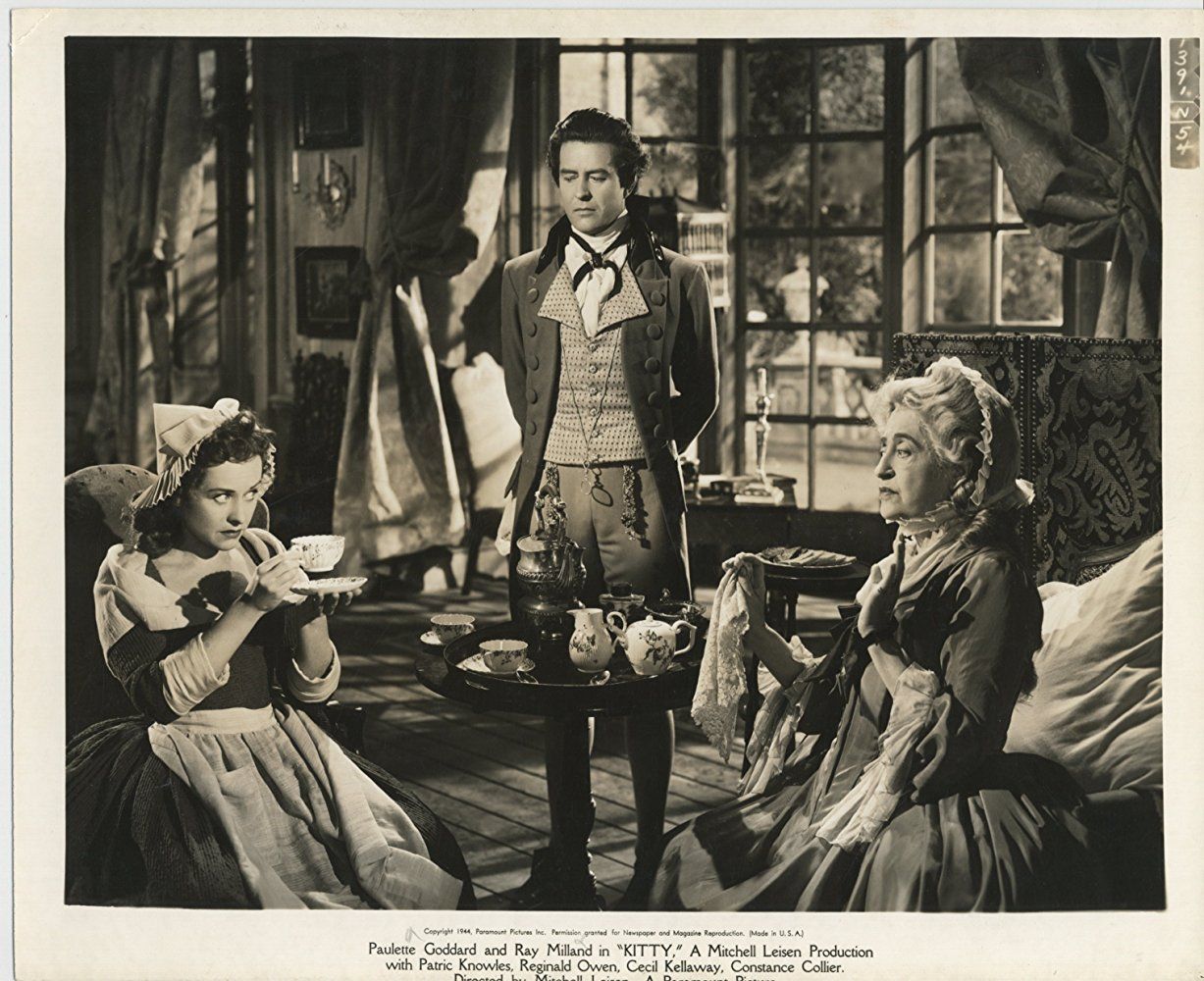
Kathleen Windsor’s Forever Amber was perhaps the most popular and conspicuous of the best selling costume novels of the forties which sought to recapture the success of Gone With the Wind and the new type of bitchy heroines who were no better than they should be. While Twentieth Century Fox were bogged down in the protracted and eventually fairly profitable though otherwise not particularly successful attempt to steer the saucy subject through the shoals of censorship, Mitchell Leisen at Paramount took Rosamond Marshall’s less popular Georgian novel Kitty and bent the larger-scaled project to the screen. Forever Amber after many production problems ran into a famous censorship battle with the Legion of Decency, was mildly defended by Spyros Skoures, later withdrawn and with grovelling apologies recut and re-released. Little of interest was left except the spectacular scenery, both Linda Darnell and the London of Charles II. But Leisen with his skill in scenic design and recreated Georgian London and with his flair for comedy highlighted the Cinderella story/Pygmalion subgenre and made of Kitty a smaller scaled and less unwieldy production. These were the years when some actresses who had made their screen reputations playing innocent or virginal roles were tarting up a bit their screen images. Soon Jennifer Jones who played the saint of The Song of Bernadette was cast as the half-breed Pearl Chavez in the meretricious Duel in the Sun. In Kitty Paulette Goddard who had begun her career as the innocent in Charlie Chaplin’s Modern Times and The Great Dictator was recreated as the saucy gutter snipe, as she was rather mildly described in the film, who sleeps her way up the English class system into Duchessdom. By the standards of the 80’s, if not those of John Crosbie, these films were all very mild affairs, their nudity restrained to what was generally described as cleavage, their emphasis on the buxom attributes of their actresses, after all the technical effect involved in the other great scandal film of the era was the aerodynamically designed brassiere designed by Howard Hughes for Jane Russell in The Outlaw. After a dozen or so years of rather heavy handed censorship both through the Code and the Legion of Decency (a good deal of which was pre-censorship or the exclusion of whole topics and approaches from the screen) these films were an attempt to treat certain aspects of some adult relationships to an audience which while still desirous of an escape from wartime reality into Hollywood dreams was asking again for a return to a sexier tone. As often happens this was slipped in through the guise of historical reconstruction of the past. On the whole this had been done rather better by Daniel Defoe and Henry Fielding than by Kathleen Windsor and Rosamond Marshall. It was not until Tony Richardson’s Tom Jones that the films achieved their masterpiece of this kind of period sexual recreation. But in Kitty Leisen combined his talents as a scenic designer and his comic tough to create a setting for one of Paulette Goddard’s better parts, possibly even the highlight of her career (except as heroine of Cecil B. DeMille’s Reap the Wild Wind). The film was amusing and financially successful, Ray Milland played her Pygmalion. Again as in most of the films of the thirties and forties the rich cast of supporting actors provided little gems of performances to set off the performances of the star. Several years before filming Kitty Mitchell Leisen had filmed Daphne Du Maurier’s Frenchman’s Creek with Joan Fontaine, Arturo de Cordova and Basil Rathbone. A spectacular color period picture (the colour unfortunately has so deteriorated that it could not be shown in this series) it told the story of a wife enticed from her wifely duties by a romantic pirate. Kitty partially belonged to this vein of Leisen’s preoccupations. But in Kitty the interest is centred more on the interrelationships of the characters and the parody of the actual life of Charles II’s whore Nell Gwynn who ended up with the title if not quite the social standing of a duchess. Kitty is the parvenu creation of a Pygmalion out of delicately alluded-to bedroom rather than linguistic skills.
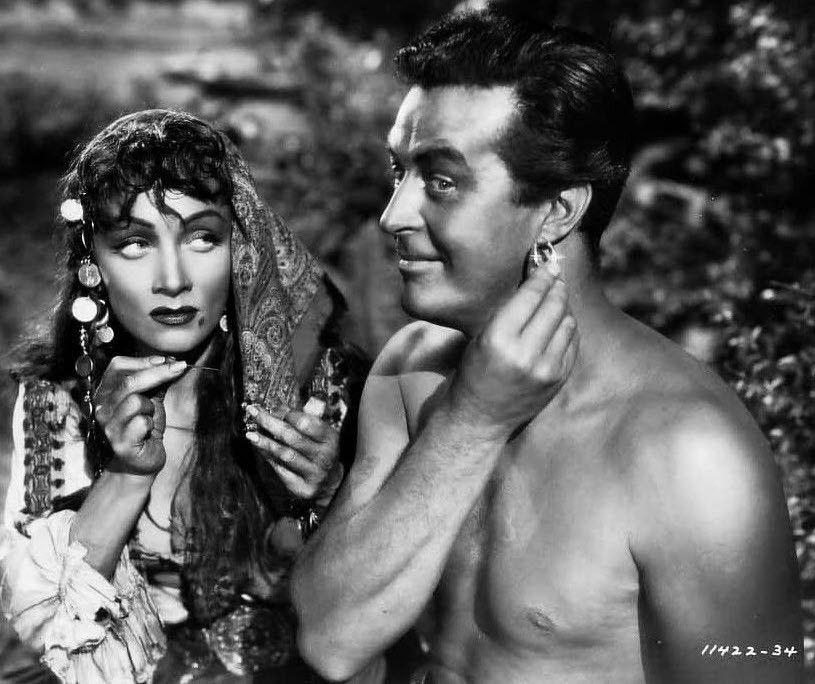
Ray Milland appears as well in Golden Earrings but in this film he is no Pygmalion. The film is an odd mish-mash of film quite popular in its time and Leisen’s last great financial success. But the popularity of the film was to a large extent based on the popularity of its title song, one of the great hits of that year. It also represented the return of Marlene Dietrich to Paramount and to Hollywood after her long absence entertaining the troops during the Second World War. Her biographers tend to gloss over this film in mild embarrassment and pass on to A Foreign Affair, the Billy Wilder film she made the next year which re-established her position in films.
But film buffs can’t pass Golden Earrings by so easily. Mitchell Leisen who had used her during her earlier Paramount period asked her specifically for this film and got her in spite of resistance from Paramount executives. Except for one great part in Destry Rides Again at the beginning of the forties Dietrich’s career had been going downhill until her years of entertaining the troops laid the basis for mythic status as an entertainer in one-woman shows that paralleled her later film career and then continued until the end of her life.
Bosley Crowther of the New York Times was moved to protest:
And, plainly, Miss Dietrich is the victim of careless sabotage, being cast and directed to play a creation which is about as far from her forte as a grandma role. It is neither appealing nor artistic to behold Dietrich, the model of svelte, smothered with some dark and oily ointment, and prancing about in dirty duds.
It didn’t seem to harm Dietrich too much. After all, she went on for years acclaimed as the most beautiful grandmother in the world. For Milland it was a reverse of his Pygmalion role in Kitty, for here he is a British officer who sloughs off all of his civilization to return to the primitiveness of gypsy life. There are Nazi spies involved in all of this, but don’t be put off by them–it is really Dietrich and the smouldering image that matters.
Notes by Roland LeBlanc
You may also like...
-

Thank You from TFS!
Our matinée on Sunday, August 17th – at the blessedly air conditioned Paradise Theatre – will conclude the Toronto Film Society’s 77th season! But take heart, as we’ll be...

Virtual Saturday Night at the Movies
Toronto Film Society will be screening Alfred Hitchcock’s Little Caesar (1931) straight to your home on Saturday, August 8, 2026 at 7:15 p.m. (ET)! Directed by Mervyn LeRoy, starring...


