
The War of the Worlds (1953) and The Day the Earth Caught Fire (1961)
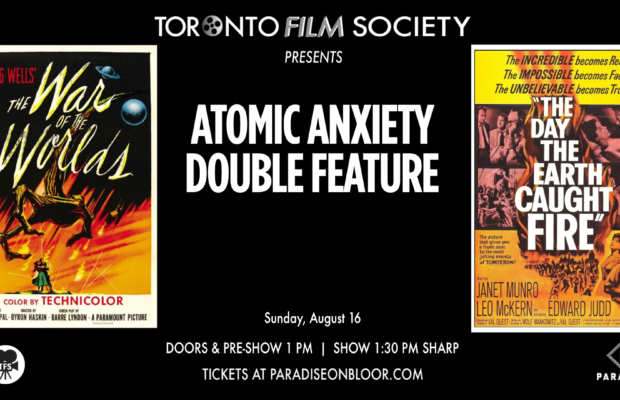
Toronto Film Society presented The War of the Worlds (1953) on Sunday, August 16, 2026 in a double bill with The Day the Earth Caught Fire (1961) as part of the Season 78 Series, Programme 10.
THE WAR OF THE WORLDS (1953)
Production Company: Paramount Pictures. Produced By: George Pal. Directed: Byron Haskin. Screenplay: Barré Lyndon, based on the novel by H. G. Wells. Cinematography: George Barnes. Music: Leith Stevens. Film Editor: Everett Douglas. Release Date: April 3, 1953. Running Time: 85 minutes.
Cast: Gene Barry (Dr. Clayton Forrester), Ann Robinson (Sylvia Van Buren), Lewis Martin (Pastor Matthew Collins), Les Tremayne (Major General Mann), Robert Cornthwaite (Dr. Pryor), Sandro Giglio (Dr. Bilderbeck), William Phipps (Wash Perry), Paul Birch (Alonzo Hogue), Jack Kruschen (Salvatore), Cedric Hardwicke (Narrator).
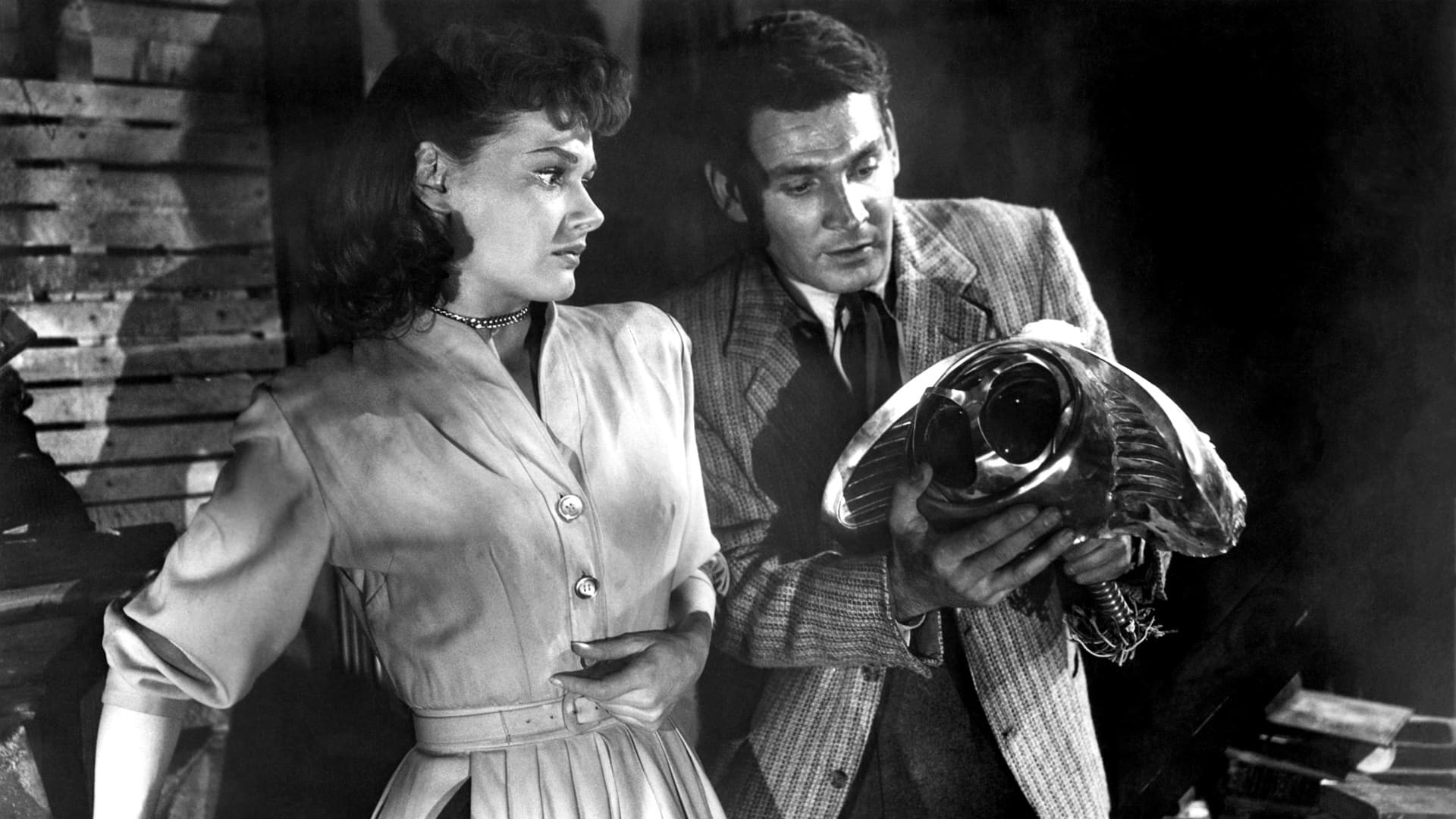
Since the dawn of humans, we have gazed up upon the stars and pondered a seemingly simple, yet brutally complex question: What exactly is out there? The question has plagued scientists, artists, and the average person for all of human history, but where the question becomes fascinating is in possible answers. We have pondered possible extraterrestrial life for thousands of years, with such tales going as far back as the 2nd century. But many consider the first modern take of aliens, specifically aliens intending to invade our little blue planet, was in H.G. Wells’ seminal 1898 novel, The War of the Worlds. Following an (obviously) fictional invasion of Earth at the hands of Martians, The War of the Worlds became one of the most celebrated genre works in literary history and remains a cultural juggernaut with Wells’ apocalyptic writings. Part of the reason the story of alien tripods vaporizing hapless humans stays so revered is because of its various adaptations. Chief among these is the 1953 film adaptation from director Byron Haskin and producer George Pal.
Following the basic premise of the novel, the film stars Gene Barry as Dr. Clayton Forrester and Ann Robinson as Sylvia Van Buren. When strange cylinders release Martian war machines hellbent on colonizing Earth after their own planet begins to lose its ability to support life, Dr. Forrester and Sylvia are thrown into a violent race for survival as the invincible Martian Menace begins to lay waste to humanity.
The War of the Worlds was birthed by an image that writer H.G. Wells had in his head. Specifically, he became entranced by the image of an empty London after some sort of mass exodus. The idea further developed when he recalled a conversation with his brother about superior beings from space. The concept of “invasion literature” was common in the Edwardian period (especially in the lead-up to the First World War), and Wells combined this popular storytelling mechanic with his idea of an extraterrestrial threat. The War of the Worlds was released on January 19, 1898, to widespread critical acclaim.
A film version of the novel had been planned as far back as 1925, with Cecil B. DeMille in the director’s chair. It was resurrected again in the 30s, with even Alfred Hitchcock himself in talks to direct at one point in time, but the film would still face hurdles. It wasn’t until veteran producer George Pal came onto the project in 1951 that the project began to pick up steam. While he originally envisioned the story being far closer to the original Wells novel, certain changes were required. While in the original novel, the main character is simply referred to as “The Protagonist” and his wife as, well, his wife, Hollywood conventions would require naming these characters, removing an “everyman” aspect from the original story. A main plot point in the novel is that the main character and his wife are separated; his primary motivation in the story is returning to her. In the film, Forrester and Sylvia meet and fall in love, becoming the romantic focus of the movie’s narrative.
Another major change is to the Martian invaders themselves and how they carry out their attack on humanity. The Martians in the novel use the now iconic tripod war machines, three-legged vehicles with heat rays, to lay waste to our civilization. The decision, however, was made in the 1953 film to alter this aspect of the story. The Martians now use war machines with “invisible legs”, giving the illusion of flight. (There is one moment where you can see an ethereal outline of the legs as the Martians make their first appearance. Keep an eye out for it!). Furthermore, their appearance changed from being akin to an octopus to a more traditional bipedal look that American audiences would be used to. Finally, while not a large change, some of the more grotesque elements of the invasion are removed, primarily the harvesting of humans.
One of the most interesting changes is in the story’s thematic elements. The original story was released in the massive wake of Darwin’s On the Origin of Species, and thus contained themes of natural selection and evolution. This was combined with the thematic relevance of the British Empire, itself the great Colonial power of the time, being colonized by a greater threat, which was a reflection of the pre-war years within the Empire. These themes are altered, if not entirely removed, for the 1953 version. Instead, the film is a heavy reflection of post-World War II America, especially in relation to the Cold War. It could be interpreted that the unstoppable Martians slowly moving across the United States could be a metaphor for Communism and how the average American at the time viewed the ideology as unstoppable. There is even a famous sequence where an atom bomb fails to stop the invading aliens, the exact tool that ended one war, but started another. There are also religious undertones not found in the Wells novel, specifically in the character of Pastor Collins (Lewis Martin). Killed early on in the film, it is somewhat fitting that the final act and eventual defeat of the Martians takes place in and around a churchful of praying refugees. Divine intervention? Or a relic of post-war, white picket fence Americana?
Despite these changes, The War of the Worlds was a financial and critical success, becoming one of the most enduring science fiction films in history. Of particular note are the Academy Award-winning special effects by Gordon Jennings, which are leaps and bounds above what others of the genre were able to put out, even into the 1970s. Sadly, Jennings died before the film premiered. The new flying Martian machines have become pop culturally significant in their own right, along with the sound effects of their weapons (the “bwowowowowo” noise that the heat rays make has been used in an untold number of films since). The story would go on to be adapted multiple times beyond this film, most prominently being the 2005 Steven Spielberg version, which would feature Gene Barry and Ann Robinson in a fan-pleasing cameo appearance.
But the film’s most interesting legacy and most significant to TFS is its 1988 sequel, a television series aptly titled War of the Worlds. George Pal had long wanted to produce a continuation to the series on television, but it would not come to fruition until after his death. The plot concerns government cover-ups of the 1953 invasion, terrorist groups being possessed by Martians, and some envelope-pushing amounts of gore. It was cancelled after two seasons, but it was filmed in Toronto, adding a cheeky hometown connection. It’s also a real treat to see the iconic flying Martian UFOs one last time (along with their “bwowowowowo” sound effect).
The War of the Worlds has surpassed the confines of 1950s science fiction and has had a life of its own. It’s a tale and film that is as grand as it is thought-provoking, exactly what Wells had wanted. It’s a story that is both introspective and reflective, but also makes us wonder if we really are alone…
THE DAY THE EARTH CAUGHT FIRE (1961)
Production Company: Val Guest Productions, Pax Films. Produced By: Val Guest, Frank Sherwin Green. Directed: Val Guest. Screenplay: Wolf Mankowitz, Val Guest. Cinematography: Harry Waxman. Music: Stanley Black, Monty Norman. Film Editor: Bill Lenny. Release Date: November 23, 1961. Running Time: 98 minutes.
Cast: Edward Judd (Peter Stenning), Janet Munro (Jeannie Craig), Leo McKern (Bill Maguire), Michael Goodliffe (Jacko, Night Editor), Bernard Braden (Dave, News Editor), Reginald Beckwith (Harry), Gene Anderson (May), Renée Asherson (Angela), Arthur Christiansen (Jeff Jefferson, Editor), Austin Trevor (Sir John Kelly), Edward Underdown (Dick Sanderson).
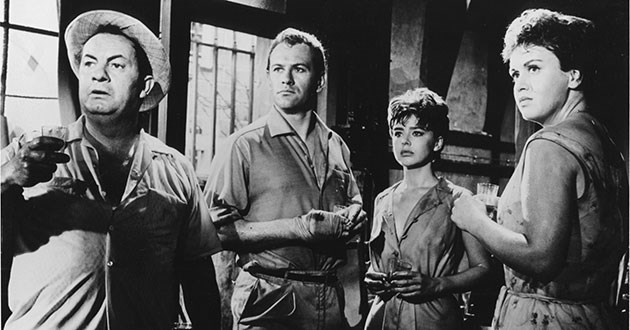
Film is one of the best tools for social commentary. It allows for artists and audiences alike to experience views and perspectives through both visuals and sound. Within that realm, science fiction is one of the best genres in which we can experience that change. One of the reasons science fiction is so notable in this regard is how malleable it is as a storytelling medium. Any topic, any question or any world can be expanded upon within the realm of science fiction in a way that allows an audience to learn or ask hard-hitting questions, all while still being entertained. While franchises such as Star Trek and films such as Eternal Sunshine of the Spotless Mind (2004) are well-documented for their use of commentary on the world, an underrated example of science fiction used as a parable for something greater is the 1961 British film The Day the Earth Caught Fire.
After the United States and Soviet Union both detonate nuclear weapons at the same time, the Earth’s rotation is violently impacted, causing the world to enter a state of cataclysm. Told from the perspective of a news team featuring journalists Peter Stenning and Bill Maguire (Edward Judd and Leo McKern respectively) and a weather reporter named Jeannie (Janet Munro), the three watch as not only the United Kingdom, but the world, begin to devolve into chaos as Earth begins to hurtle towards the sun.
The film was the brainchild of writer/director Val Guest, best known for his directing of the early Quatermass films, part of Hammer’s horror repertoire, as well as being one of several credited directors on the 1967 James Bond spoof Casino Royale. Despite his success as both a screenwriter and a director, he struggled to get The Day the Earth Caught Fire off the ground, largely due to the contentious subject matter of the ongoing Cold War causing an irreversible disaster for the planet. Finally, the success of his 1959 film Expresso Bongo allowed Guest to receive the green light.
Val Guest was an expert at taking seemingly mundane concepts or locations and making them terrifying, a strong example being his turning of a refinery in Quatermass 2 (1957) into a sterile and otherworldly alien base, largely through the use of ambient sounds and uncomfortable cinematography. He puts such a technique to great effect in The Day the Earth Caught Fire, especially during the opening and closing scenes where we see desolate looks at London. Through the use of both echoing soundscapes, clever framing, as well as miniatures and composites, Guest creates a macabre depiction of an ending world at the point of no return. He also utilized stock footage for depicting the ecological disasters unfolding across the globe. While such a choice was common for science fiction films of the 1950s and 1960s, its inclusion works particularly well here due to the narrative being told from the perspective of newsmen. The utilization of this stock footage thus has an effect of being mise-en-scène strangely, adding a bizarre and not totally comfortable sense of realism to a concept which is otherwise purely fantastical.
Going along with this production value is the high quality of original effects during the disaster scenes. One in particular is when a devastating cyclone ravages London, causing thousands to perish in the process. We see a clever use of miniatures, rear projection and even full-sized, in-camera effects. One that stands out is a dock in a boatyard violently swaying in the wind as the actors run across it. It conveys a realistic feeling of danger that you just don’t find in a lot of films nowadays. What’s interesting in hindsight is that the destruction scenes here are very similar in composition and content to those found in the climax of the 1967 film Quatermass and the Pit, the third in the Quatermass trilogy and the only entry that Val Guest did not direct. Perhaps Pit director Roy Ward Baker paid tribute to Guest in that way.
While not the most famous atomic age science fiction venture, The Day the Earth Caught Fire has a special way of staying relevant. Not only has its anti-war messaging stayed prominent, especially as there are still destructive conflicts across the world and the topic of nuclear weapons is still being brought up, but especially in terms of climate change. A major throughline within the narrative is how the weather keeps changing as the Earth’s rotation and trajectory continue to alter. The aforementioned natural disasters occur, yes, but the temperature in particular begins to rise in the United Kingdom. All throughout the film, the characters are glistening in the heat; the scenes seemingly permeated by the miasmatic odour of sweat. The black and white film is even bookended by colour-tinted sequences to display the heat of the sun. As temperatures in our own world continue to rise and as scientists sound the alarm on our own climate woes, the content of the film becomes all the more scary.
The Day the Earth Caught Fire made a profit at the British box office, but never truly gained the heights of cultural reverence that several of its contemporaries did. Perhaps the most interesting way the film stayed within popular culture is a case of possible parallel thinking (or perhaps theft, but that’s pure conjecture). A few days before the premiere of the film, The Twilight Zone debuted its story entitled The Midnight Sun, a tale in which the Earth’s orbit changes and we start to whizz towards the sun. Told from the perspective of a young woman on what writer/series creator Rod Serling calls the “hottest day on Earth”, it is an effective microcosm of what the full The Day the Earth Caught Fire stands for and has since gone on to be one of The Twilight Zone’s most enduring episodes.
At the end of the day, the science of The Day the Earth Caught Fire isn’t winning any Nobel Prizes for its precise accuracy, nor is it standing on the Mount Rushmore of science fiction films. But it remains a fascinating parable of the Cold War. And who knows? The day may come when we face down the threat of our own world catching fire.
Notes by Ryan Tocheri
You may also like...

-
Support Classic Cinema: Toronto Film Society Sponsorship Opportunities
Toronto Film Society Corporate Sponsorship 2026/27 About TFS Founded in 1948, the Toronto Film Society is one of Canada’s oldest film appreciation groups. It was originally formed to meet...
Virtual Saturday Night at the Movies
Toronto Film Society will be screening Alfred Hitchcock’s Lady Windermere’s Fan (1925) straight to your home on Tuesday, September 29, 2026 at 7:15 p.m. (ET)! Directed by Ernst Lubitsch,...


