
Gold Diggers of 1933 (1933) and Lili (1953)

Toronto Film Society presented Gold Diggers of 1933 (1933) on Sunday, May 10, 2026 in a double bill with Lili (1953) as part of the Season 78 Series, Programme 7.
GOLD DIGGERS OF 1933 (1933)
Production Company: Warner Bros. Pictures. Produced by: Robert Lord, Jack L. Warner. Directors: Mervyn LeRoy, Busby Berkeley (musical sequences). Screenplay: Erwin S. Gelsey, James Seymour, with dialogue byBen Markson, David Boehm, based on The Gold Diggers 1919 play by Avery Hopwood. Cinematography: Sol Polito. Music: Harry Warren (music) Al Dubin (lyrics). Film Editor: George Amy. Release Date: May 27, 1933. Running time: 90 minutes.
Cast: Warren William (J. Lawrence Bradford), Joan Blondell (Carol King), Aline MacMahon (Trixie Lorraine), Ruby Keeler (Polly Parker), Dick Powell (Brad Roberts), Guy Kibbee (Faneul H. Peabody), Ned Sparks (Barney Hopkins), Ginger Rogers (Fay Fortune).
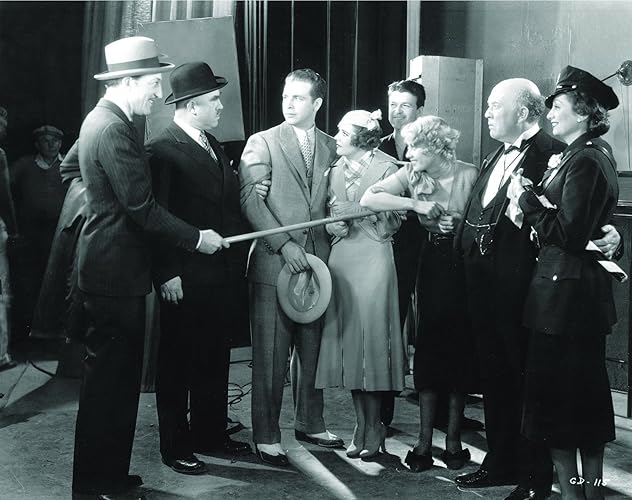
The Great Depression was an era of change, with huge cultural shifts happening globally, in addition to the economic woes of the time. Coming out of the devastation of World War I and subsequent boom time and stock market crash, the world was ready for escapism – as screenwriter Andrew Bergman later said, “a nation could drown its sorrows in legs and glitter.” And Gold Diggers of 1933 provided both of those in spades.
Considered a Pre-Code film (the Hays Code was adopted in 1930 but not really enforced until 1934), Gold Diggers overturned the out-dated “seduction plot” – a tragic tale in which an ingenue was seduced by an older rake – instead presenting young women out to seduce wealthy men in comic fashion. The original 1919 play that the film was based on introduced the term “gold diggers” as well as the concept, and was popular enough to have been previously adapted to film twice (ini 1923 and 1929). The idea was so in demand that when Warner Brothers began re-adapting the script in 1932, they did so under a veil of secrecy, with the working title “High Life,” as well as seeking a legal injunction against other production companies, preventing them from using “any title containing the words ‘gold diggers.’” The script underwent numerous rewrites, with characters added and removed, as well as writers being added and removed. It was “the product of a group of Hollywood wordsmiths hired to put together something that could be filmed quickly.” Originally not intended to be a full musical, after the success of 42nd Street they drafted songwriters Al Dubin and Harry Warren, and went back to the studio with Busby Berkeley to shoot musical numbers that set the standard for musicals to come.
The hallmarks of Berkeley’s style are “costumes, props, pulchritude, and geometry… a boom shot, a tracking shot, an overhead shot.” In Gold Diggers, the musical number “Pettin’ in the Park” features a classic overhead shot, with dancers forming a circle and movement created “via the cinematic means of his innovative camerawork rather than solely by choreography.” He also introduced shadowplay scenes, both in “Pettin’ in the Park” in which chorus girls undress behind screens (tiptoeing around the limits of censorship boards) and silhouetted soldiers in the final number “Remember My Forgotten Man.”
Before Hollywood, Berkeley worked as a choreographer; Samuel Goldwyn brought him to California to re-create his Broadway production numbers for Eddie Cantor. Before Broadway, he fought in WWI. His army service is crucial to the genesis of his style – discovering the value of overhead shots while serving as an aerial observer, as well as staging parades and marching drills, learning the skill of managing 200 people in formation.
Numbers such as “Remember My Forgotten Man” elevate Gold Diggers. This was a point in time that saw a “decisive shift from hokum to sophistication,” from sentimentality to satire. Scholar Michael Roth would argue that rather than pure escapism, “the great Warner Brothers musicals are essentially political,” in part due to the dance numbers which require cooperation and collective effort rather than individualism, as well as a plot revolving around the threat of poverty – it begins with rehearsals for a stage show being closed down due to unpaid bills. The Depression Era “raised questions about the viability of American capitalism… musicals and crime films were the two major film genres to explore this crisis.”
Perhaps not coincidentally, director Mervyn LeRoy cut his teeth directing crime films. After working his way up from starting as a wardrobe assistant, then film tinter, then gag writer and finally screen writer, he moved to directing comedies in the silent era, before his 1931 film Little Caesar “invented the gangster genre.” He became associated with “contemporary tough dramas… he carried his fast, won-to-earth, socially relevant tone over into musicals such as Gold Diggers of 1933,” a fable “stressing the divide between struggling show folk and old money types” with numbers like “Remember My Forgotten Man” fusing “social realism and musical spectacular.”
Whether purely escapist or not, the film is straight fun, filled with glittering stars like Ruby Keeler and Joan Blondell, and launching the career of Ginger Rogers (who famously sings “We’re in the Money” in Pig Latin). The plot can stand on its own, and is only enhance by “one of the top-notch song scores of any picture ever.” And there is the straight titillation of the showgirls, enough that “alternative scenes were filmed and inserted into prints bound for troublesome areas” where censorship boards might otherwise make their own cuts. The result is a perfect blend of social satire and wise-cracking fun.
Notes by Jennifer Amey
LILI (1953)
Production Company: Metro-Goldwyn-Mayer. Producers: Edwin H. Knopf. Director: Charles Walters. Screenplay: Helen Deutsch, based on the short story The Man Who Hated People, 1950 in The Saturday Evening Post by Paul Gallico. Cinematography: Robert H. Planck. Film Editor: Ferris Webster. Music: Bronisław Kaper, Gerald Fried (uncredited). Release Date: March 10, 1953. Running time: 81 minutes.
Cast: Leslie Caron (Lili Daurier), Mel Ferrer (Paul Berthalet), Jean-Pierre Aumont (Marc), Zsa Zsa Gabor (Rosalie), Kurt Kasznar (Jacquot).
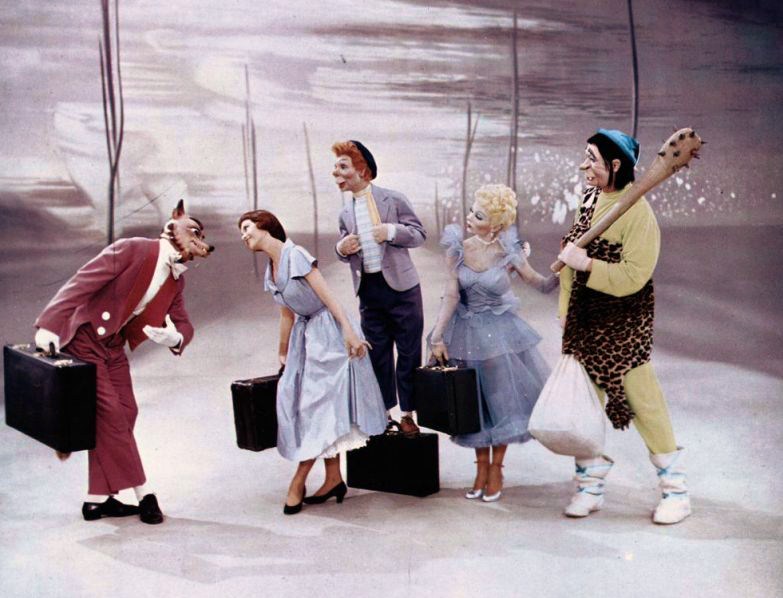
Released by Metro-Goldwyn-Mayer in 1953, Lili remains one of the most unusual and quietly affecting productions of Hollywood’s golden age. Directed by Charles Walters and starring Leslie Caron in one of the defining performances of her career, the film initially presents itself as a whimsical Technicolor musical set against the colorful backdrop of a traveling carnival. Yet beneath its bright circus tents, playful melodies, and romantic surface lies a story surprisingly rooted in abandonment, emotional repression, and the fragile ways damaged people learn to ask for love.
At a time when MGM musicals were largely associated with glamour, exuberance, and spectacle, Lili offered something softer and more introspective: a melancholy fairy tale disguised as light entertainment.
The story centers on Lili Daurier, a naïve sixteen-year-old orphan wandering alone through provincial France after the death of her father. Hungry, vulnerable, and with no family to turn to, she stumbles upon a traveling carnival after becoming infatuated with Marc, a handsome magician whose flirtatious charm quickly reveals itself to be shallow. While Marc represents the glamorous illusion of romance, it is within the puppet theater that Lili finds her first true emotional connection.
There she encounters Paul Berthalet, a bitter and physically disabled puppeteer played by Mel Ferrer. Unable to express affection openly, Paul speaks to Lili through his four puppets – Reynardo the fox, Marguerite the ballerina, Golo the giant, and Carrot Top the mischievous boy. To Lili, the puppets seem alive; to the audience, they gradually become something far more poignant: fragments of Paul’s own hidden personality. Through them, he can tease, comfort, protect, and even love in ways his wounded pride prevents him from doing as himself.
This puppet relationship forms the emotional core of Lili and is what gives the film its enduring fascination. On one level, it functions as charming fantasy; on another, it is a subtle psychological portrait of emotional displacement. Paul’s puppets are not merely stage props but masks – extensions of feelings he is incapable of voicing directly. In many ways, the film becomes a meditation on how adults construct elaborate performances in order to shield their vulnerabilities, while Lili, with all her innocence, responds only to honesty, even when it comes from wood and fabric.
That emotional complexity is what distinguishes Lili from most studio musicals of its era. Though wrapped in pastel colors and circus pageantry, the narrative repeatedly returns to darker undercurrents: orphanhood, attempted exploitation, physical disability, humiliation, jealousy, and the fear of abandonment. Lili is not simply a whimsical ingénue drifting through a fantasy world; she is a lonely child searching desperately for a place where she can feel safe. Likewise, Paul is not the standard romantic hero, but a wounded man so consumed by self-loathing that he can only reveal tenderness through performance. The result is a film suspended between innocence and sadness – one that feels both magical and strangely haunted.
Behind the scenes, Lili had an equally distinctive journey to the screen. The screenplay by Helen Deutsch was based on a story by Paul Gallico, whose original material, titled The Seven Souls of Clement O’Reilly and derived from his earlier short story The Man Who Hated People, provided the central concept of a lonely girl falling in love with a man through his puppets. Deutsch reshaped the material into a European carnival setting, giving the film its fairy-tale atmosphere while preserving the unusual emotional premise.
MGM initially had little confidence in the project. According to studio records, executives feared the film lacked broad commercial appeal and considered it too delicate and unconventional for mass audiences. In fact, studio head Dore Schary later recalled that the picture was viewed internally almost as an “art-house” gamble rather than a mainstream musical. That hesitation makes its eventual success all the more remarkable.
The production also marked an important turning point for Leslie Caron. After being discovered by Gene Kelly and launched to fame in An American in Paris, Caron had been primarily showcased as an elegant dancer. Lili finally gave her the opportunity to anchor an entire film through character rather than choreography. As the title heroine, Caron strips away glamour in favor of vulnerability, awkwardness, and emotional transparency, creating a performance of remarkable sincerity. Her interactions with the puppets – which demand complete conviction in scenes opposite inanimate objects – remain among the film’s most enchanting achievements. Critics responded enthusiastically, and Caron received her first Academy Award nomination for Best Actress.
Director Charles Walters, previously known for more conventional MGM musicals, approached the material with notable restraint. Rather than overwhelm the story with large production numbers, Walters allows mood and intimacy to dominate. The carnival setting is colorful, but never distracts from the isolation at the heart of the film. Cinematographer Robert H. Planck’s lush color photography earned its own Academy Award nomination, while the art direction creates a dreamlike environment that feels at once playful and faintly unreal – a fitting visual counterpart to a story built on illusion.
Equally essential to the film’s identity is its music. Composer Bronisław Kaper provided one of the most lyrical scores of the decade, balancing childlike wonder with quiet melancholy. His work earned the Academy Award for Best Original Score, the film’s only Oscar win. The picture’s signature song, “Hi-Lili, Hi-Lo,” with lyrics by Helen Deutsch and music by Kaper, became an immediate standard and remains inseparable from the film’s wistful tone – deceptively cheerful, yet tinged with sadness.
Upon its release, Lili exceeded expectations both critically and commercially. The film became one of MGM’s most profitable musicals of 1953 and played for an extraordinary year-long run at New York’s Trans-Lux Theatre. At the 26th Academy Awards, it received nominations for Best Actress, Best Director, Best Screenplay, Best Cinematography in Color, and Best Art Direction in Color, in addition to its win for Best Score. The film also earned international recognition at the Cannes Film Festival, where it received an International Prize and Special Mention, while Caron won the BAFTA for Best Foreign Actress.
Its influence continued well beyond its original theatrical life. In 1961, the film was adapted into the Broadway musical Carnival!, which ran for more than seven hundred performances and introduced the story to a new generation of audiences. Yet the film itself has retained a singular place in MGM history precisely because it does not behave like a traditional MGM success. It is too emotionally strange, too inward, and too tenderly sad to fit neatly alongside the studio’s brighter entertainments.
Today, Lili endures as a cinematic contradiction: a musical that often feels like a character study, a romantic fantasy haunted by loneliness, and a carnival spectacle whose most memorable conversations take place not between lovers, but between a lost girl and four puppets. That tension between whimsy and sorrow is what gives the film its lasting charm. Beneath the painted smiles and cheerful melodies, Lili understands something deeply human – that sometimes the most sincere declarations of love arrive only when spoken from behind a mask.
Notes by Leandro Matos
You may also like...


-

Thank You from TFS!
Our matinée on Sunday, August 17th – at the blessedly air conditioned Paradise Theatre – will conclude the Toronto Film Society’s 77th season! But take heart, as we’ll be...
Virtual Saturday Night at the Movies
Toronto Film Society will be screening Alfred Hitchcock’s Lady Windermere’s Fan (1925) straight to your home on Tuesday, September 29, 2026 at 7:15 p.m. (ET)! Directed by Ernst Lubitsch,...


